
Chelsea retained the Subway Women's League Cup with a performance that underlined why, despite the turbulence surrounding them this season, they remain the team to beat in English football. A 2-0 victory over Manchester United in Bristol extended the Blues’ dominance over their rivals to three finals and handed Sonia Bompastor her fourth trophy since arriving at Stamford Bridge.
It was Lauren James who provided the star turn of the final, capitalising on a Dominique Janssen error to open the scoring with the kind of composed finish that has come to define her style of play.
The Chelsea forward was the standout performer in a game where her team controlled possession, but Manchester United caused them a host of problems, including Elisabeth Terland rattling the crossbar.
The second half saw their resilience kick in as Sonia Bompastor’s side used all their experience to frustrate United before Aggie Beever-Jones made it 2-0, making the scoreline much more comfortable for the defending champions.
Across the ninety minutes, Chelsea were the dominant force, controlling the tempo and dictating the terms of engagement. United showed enough to suggest they are capable of challenging, but once again found that closing the gap and crossing it are two very different things against this Chelsea side.
In this analysis, we will examine how Sonia Bompastor set up her team to systematically close off central passing lanes to nullify United's most dangerous players and how their press forced the errors that ultimately decided the final.
Line ups
Bompastor opted for a 4-3-3 with Lauren James deployed as something of a false nine, a decision that would prove pivotal to Chelsea's control of the final. The shape gave Chelsea a fluid, interchangeable front line with Rytting Kaneryd and Thompson providing width while James was free to drop and influence play between the lines. Whilst in midfield, the combination of Walsh, Cuthbert and Nüsken offered both defensive solidity and the physical capabilities to put their opponents under constant pressure.
As expected, Marc Skinner set United up in a 4-2-3-1, with Zigiotti Olme and Naalsund providing the double pivot and Jess Park operating in the right channel of the three behind Wangerheim. In theory, Manchester United set up to be compact and hard to break down, with the width of Riviere and Lundkvist offering potential outlets on the counter.
Neither side was at full strength, though. Chelsea were without Millie Bright and Naomi Girma at the heart of their defence, two of their most influential defenders, while United missed the creative spark of Ella Toone and Anna Sandberg in the final third. The Asia Cup had further depleted both squads in the weeks prior, with Hinata Miyazawa absent for Marc Skinner’s side and both Ellie Carpenter and Sam Kerr unavailable for Chelsea.
The absences gave the final an additional layer of context; neither side was at their absolute peak. However, as the afternoon unfolded, Chelsea demonstrated that despite the injuries, they had what it took to defend their title.
Chelsea forcing errors
Chelsea’s tactical setup has been somewhat disjointed this season, with Bompastor searching for answers to her team’s struggles. In the Subway League Cup Final, though, Chelsea looked back to their confident, well-drilled best.
From the first whistle at Ashton Gate, there was an immediacy and intensity to their play that has been absent at points during a difficult BWSL campaign. It was the kind of front-foot performance that characterised their unbeaten domestic treble last season, organised and ruthless when the moment arrived.
So, when Janssen's error handed James the opening goal, it felt like the result of Chelsea's intelligent pressing rather than purely down to a defender's error.
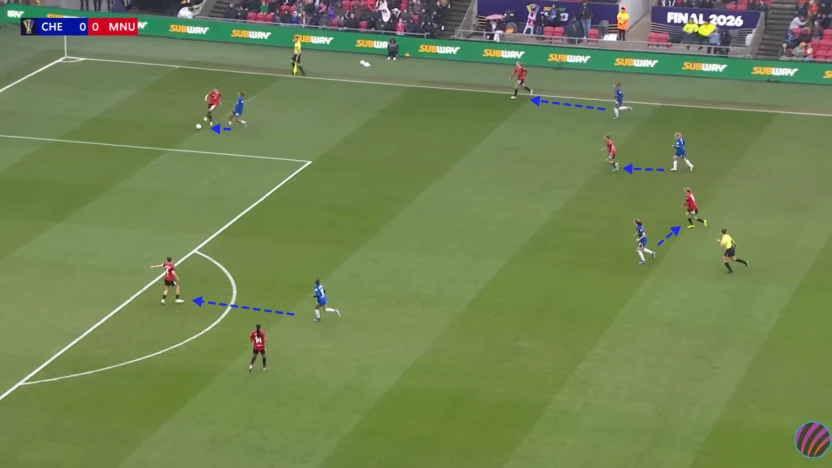
This is the lead-up to the opening goal. On the surface, it appears to be a straightforward error by Janssen, but in fact, Chelsea's press is in full flow, and that leads to indecision in the defensive line. James is putting the centre-back under pressure while Chelsea's midfield has already cut off the passing lanes ahead of her, leaving Janssen with no viable option to play forward.
Her only realistic escape route in this moment is to play it back to Tullis-Joyce, but with Chelsea's press so well-organised and advanced, the goalkeeper would have been immediately under pressure and forced to go long.
In this situation, Manchester United had no way out, which likely contributed to Janssen’s lapse in concentration, as she knew that Chelsea were already positioned to win the second ball and turn over possession in a dangerous area.
This may be a small detail, but it certainly speaks to the quality of Bompastor's setup and the confidence of her team. This goal wasn’t simply down to an individual mistake; the error was forced by Chelsea’s pressure, which pushed their opponents backwards and into difficult decisions in their own defensive third.
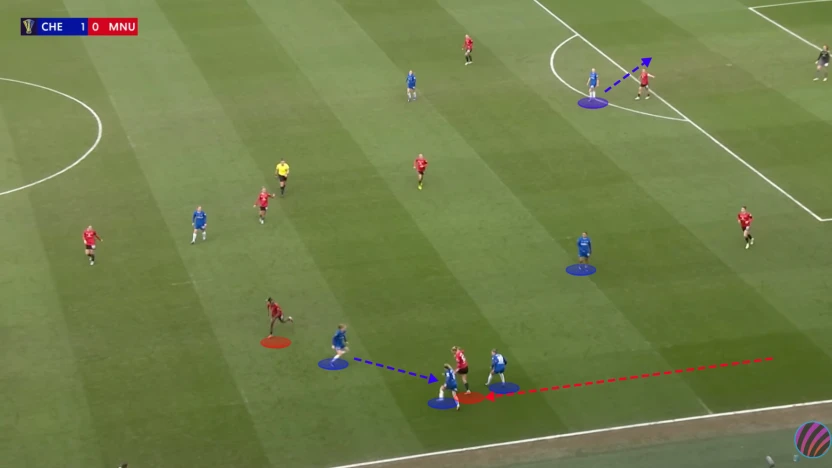
The second goal told a familiar story. Two-time Champions League winner Fridolina Rolfö had been introduced to give Manchester United greater dynamism down the left flank, but it was the Swedish international’s error that led to her team conceding a second.
Looking to drive forward as she consistently does, carrying the ball down the left, Rolfö found herself immediately surrounded by three Chelsea players. The press had been triggered again, the same coordinated mechanism that had worked so well in the first half.
To her credit, Rolfö was attempting something constructive rather than simply clearing her lines. We can see that had she been able to pick out Malard, United would have had a counterattacking opportunity, and they might have been able to carve out a goal-scoring chance from it.
However, Chelsea's press gave her no time to execute it. Three players in blue surrounded her simultaneously, removing any margin for error, and when the ball was turned over, it was advantage Chelsea.
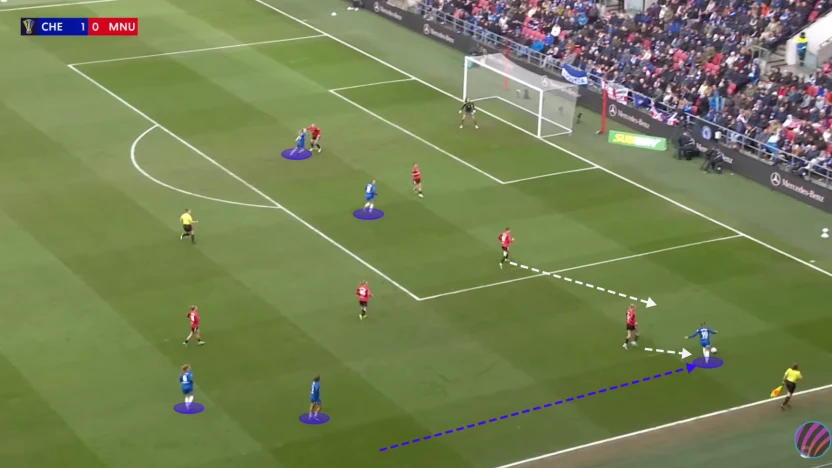
Nüsken intercepted the pass and immediately set Rytting Kaneryd free into the space Rolfö had vacated by committing forward. The Chelsea winger then wasted no time in delivering the ball into the box, where Beever-Jones won her battle with her opponent and ensured it found the back of the net.
There is an argument that Rolfö could perhaps have recovered more quickly to close down the cross, and that Janssen could have offered more support in dealing with the danger; those are marginal details, though and probably wouldn’t have made much difference as Rytting Kaneryd’s cross was an excellent one.
Once again, the press was working exactly as Bompastor had designed it. She watched on as Nüsken won the ball back quickly, Rytting Kaneryd exploited the space left behind, and then Aggie Beever-Jones provided the finish.
Wide combinations
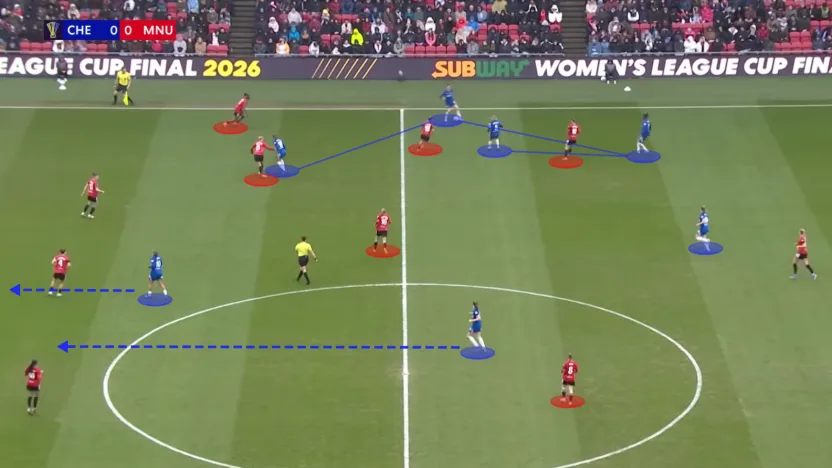
Bompastor clearly sent her team out with a plan. They frequently looked to make the most of Lucy Bronze's attacking instincts down the right flank, using her to drag United across the pitch and open up the central spaces that James, Nüsken and Thompson were primed to exploit.
Bronze, who has spent much of this season operating as the right-sided centre-back in a back three, looked liberated in a fullback role and put her stamp on the game from the opening minutes. She stayed wide on the right, linking effectively with Rytting Kaneryd to create a reliable overload on that side that United were forced to respond to.
As we can see in the image, the fullback has the ball out wide on the right with multiple options around her - Buchanan, Cuthbert and Rytting Kaneryd all available. The effect on United's shape is immediate. Malard and Lundkvist are the left winger and left back, so they would be engaging on that side as normal, but Zigiotti Olme and Terland have also shifted across to engage, compressing United's defensive structure towards the right side of the pitch.
In doing so, they have almost entirely vacated the central areas. James and Nüsken have the opportunity to make runs in behind or drive forward, forcing the defensive line backwards.
United's ability to cope with Chelsea's wide overloads was likely influenced by Miyazawa's absence. With the Japanese international unavailable, Skinner was forced into a midfield reshuffle that subtly but significantly altered the balance of his double pivot.
Miyazawa is a pure defensive midfielder; she is disciplined and positionally astute. Her primary focus is always on protecting the backline. Her presence would ordinarily have provided the defensive anchor that allowed Zigiotti Olme the freedom to be more box-to-box. Instead, Zigiotti Olme was required to drop into the holding role herself, with Naalsund pushing into the more advanced position.
The Swedish midfielder is at her best when pressing aggressively and driving into space, rather than sitting and protecting. Asking her to suppress those tendencies and protect the space against Chelsea's movement was a significant ask.
With some of Chelsea’s wide play stretching their shape, even the slightest miscalculation in defensive positioning could open up gaps within the Manchester United structure. Coupled with the intensity the Blues seemed to play with, especially in the first half, this was always likely to cause problems for the Red Devils.
Compact defence
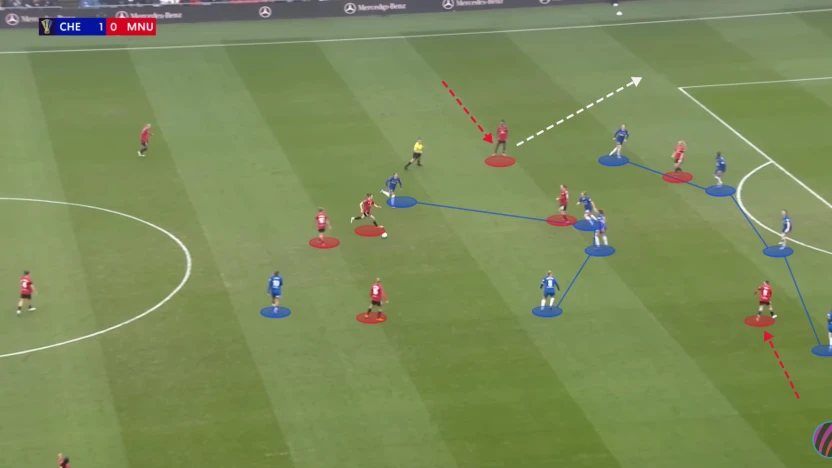
Defensively, Bompastor set her side up to be extraordinarily difficult to play through centrally, and the consequences for United's attacking players, especially Jess Park, were suffocating.
Park is undoubtedly United's most dangerous creative player. Her ability to find pockets between the lines, receive and turn under pressure and then drive forward is what makes her such a difficult player to handle. Bompastor knew this, and as a result, Sandy Baltimore was clearly tasked with sticking to Park like glue. A role she seemed to thrive in, all afternoon.
Wherever Park looked to drop, spin or find space, Baltimore was there. Her performance was physical and uncompromising, meaning the player who has been the difference maker in big games for United this season was effectively removed from the contest before she ever had the chance to influence it.
Additionally, United’s desire to play through the middle really did limit their ability to create meaningful goalscoring opportunities. We can see the compact defensive unit here. Notice how narrow Park and Malard are; this makes it much easier for the Blues to close off central passing lanes. If Malard were to drift wide, it would force Bronze to go with her and perhaps open up more space for Wangerheim and/or Terland in the half-space and through the middle.
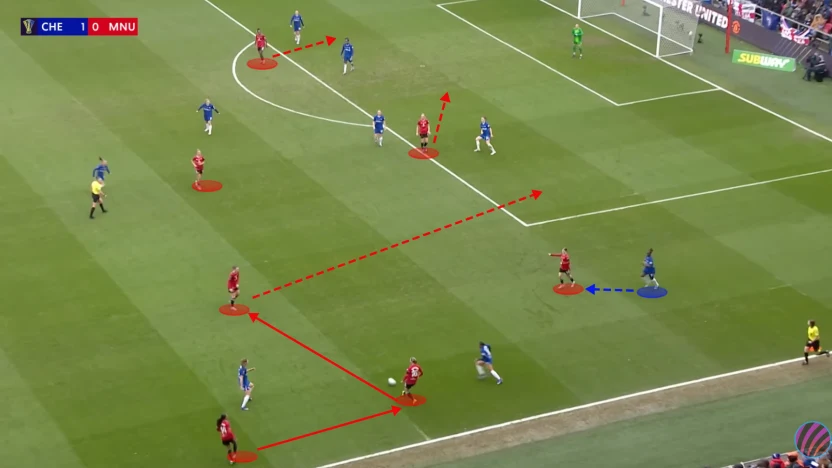
Moreover, when Marc Skinner’s side did manage to shift play wide, they found their most promising moments of the final.
By sticking to her task and following Park so diligently, Baltimore was occasionally dragged out of her position within the compact shape, leaving half-spaces available for United to exploit. A good example of this can be seen here, when Riviere and Naalsund linked up out wide before playing in Terland.
With Park having pulled Baltimore further out wide, Terland was able to carry the ball into the box with time and space, executing a powerful shot that rattled the crossbar. This was United's best moment of the game, and it came directly from the unintended pocket of space that Baltimore's player-marking had created.
Unfortunately for Manchester United, these moments were too infrequent and too isolated to mount a sustained threat. Chelsea held their defensive shape reasonably comfortably and were resolute in defending their penalty area.
Conclusion
This final was Chelsea at their tactical best. They defended their title aggressively and ruthlessly. Bompastor had clearly done her homework, setting up her team to be astute in the press and ensure United’s most creative player couldn’t get on the ball.
Her plan was executed with a collective discipline that underlined why Chelsea remains the dominant force in domestic cup football.
For United, this will hurt. They’ve now played three finals against Chelsea, all ending in defeat. They were not without their moments, but moments are not enough against a side capable of executing a tactical plan perfectly.
For Chelsea, this victory carries a significance that extends beyond the trophy itself. It has been a difficult season in the league. A poor run of form saw Bompastor's side fall behind in the title race and face growing questions about whether the dominance of their unbeaten treble-winning 2024/25 campaign could be sustained. The critics grew louder with each dropped point, and each unconvincing performance was seen as a sign that the gap between Chelsea and their rivals was beginning to close.
This final will not silence those critics entirely, but whatever has happened in the league this season, Bompastor has shown a remarkable ability to have her side ready for the big moments. The Subway Women’s League Cup is retained, and Chelsea have shown they still know how to deliver when it matters.