
When London City Lionesses replaced Jocelyn Prêcheur with Spaniard Eder Maestre last December, more than a few eyebrows were raised among fans. The Barclays Women Super League's first and only independent team were 6th, 12 points clear of the then bottom side Liverpool. Better yet, just seven off of the UWCL places. On their top flight debut.
Lionesses had shown great ambition with 16 new signings - among them, UEFA Women’s Euro winner Daniëlle van de Donk and her former OL Lyonnes teammate Nikita Parris - and had won 5 of their opening 11 matches. Although Precheur’s final two matches in charge ended in defeats to Brighton and Leicester, his dismissal was most unusual.
It perhaps shouldn’t come as a surprise that the club has chosen to operate on a bold strategy that wasn’t based on results, stating it “believes that now is the right time to begin a new cycle and pursue a different strategic direction for the next phase of its development.”
The change was said to be influenced by desire to replicate the intricate possession-based styles used by Spanish clubs, and Lyon, also owned by American businesswoman Michele Kang. But Maestre has one win in his first 8 matches in charge, losing 4 and drawing 3.
With the club now 7th and 5 points further away from 3rd place than they were before the winter break, despite ambitions of European football by 2026, is the gamble really paying off?
Chances today, fewer tomorrow
Prêcheur’s history of wanting to dominate the ball, added further intrigue to London City Lionesses seeing the need to change manager, averaging over two thirds of possession in his matches in charge of 2023/24 UWCL semi finalists Paris Saint Germain.
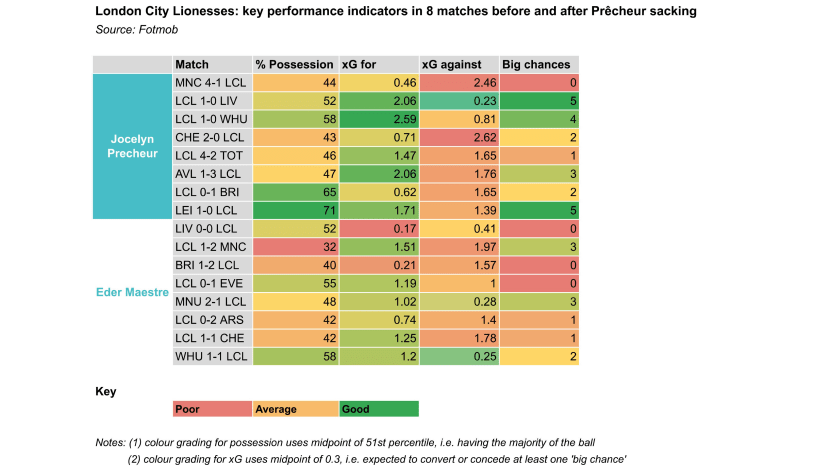
This was also reflected by his Lionesses having over 52% against Liverpool, West Ham, Brighton, and Leicester, yet the data shows it didn’t always entail maximum points. Lionesses put four past Tottenham and three past Aston Villa having had less than 50% of possession, but lost to Brighton and Leicester having dominated the ball.
With an average of 53% possession in Prêcheur’s final 8 games in charge, London City Lionesses scored 10 goals and generated 1.3 expected goals (xG), but only 6 goals and 0.9 xG per game under Maestre, indicating that they have become slightly less productive. It should be highlighted, though, that the difference in average xG is marginal.
‘Big chances’, described by Opta as scenarios “where a player should reasonably be expected to score” are often used as a more descriptive, context-dependent way to illustrate how creative a team is with the ball than xG, which is primarily a measure of shot quality.
It’s here that we start to see a difference. Prêcheur failed to create any big chances just once in his last 8 games, the 4-1 defeat at champions elect Manchester City, and averaged 2.6 per match. Maestre, on the other hand, saw his side fail to create a big chance 3 times. This resulted in an xG of just 0.17 on his debut against the then still winless Reds.
Maestre has struggled to create as many notable chances as Prêcheur, 12 less than his 22 in the same number of matches leading up to his departure. This will frustrate him more so given that his team had proven it was possible to beat Liverpool and West Ham.
Therefore, the data raises two main questions. Why did his team create so little against Liverpool and draw, yet win against the Seagulls with nearly as low an xG? Secondly, what cost him the win at West Ham last month?
Lionesses still adjusting to change in width
Some of London City Lionesses’ best attackers are out wide, including the aforementioned Parris and wing-backs Jana Fernández and Lucia Corrales, both of whom are current internationals for Spain. Prêcheur and Maestre picked up on this, yet have incorporated their forward threat in slightly different ways.
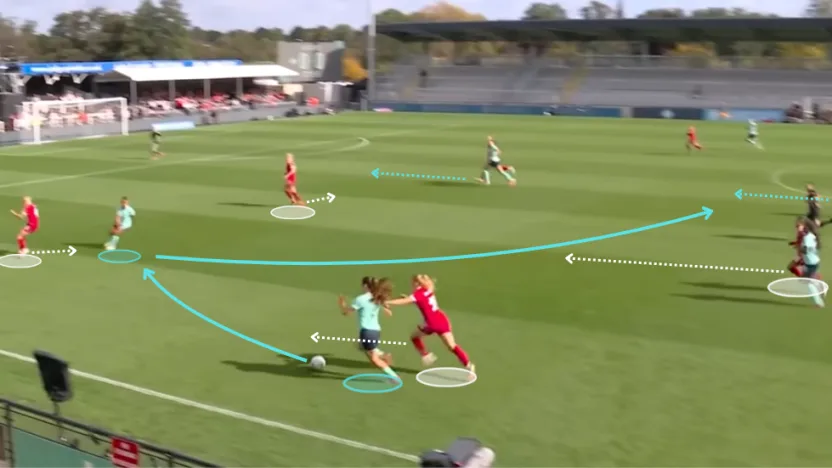
Here, against Liverpool, Lionesses are operating with a 4-4-2 formation, and begin this attack by moving the ball across defense to Corrales. The left back makes good progress out wide, before finding Parris in a smart position just inside and dragging several players away from the central areas in order to prevent the return pass and close down her ball into Kosovare Allsani.
In turn, this creates space for Allsani to charge forward and thread a promising ball in behind to her strike partner Isobel Goodwin, with her markers fixated more on the Fin. Although the final pass had too much on it, the Reds were left scampering to cover the space.
Both Corrales and Fernandez were well supported by Parris and Sanni Franssi on the other side throughout the match, meaning they had the freedom to bend crosses into the box or move it on to a teammate running behind the defense and into the penalty area. However, these instances were scarcer in their goalless draw.
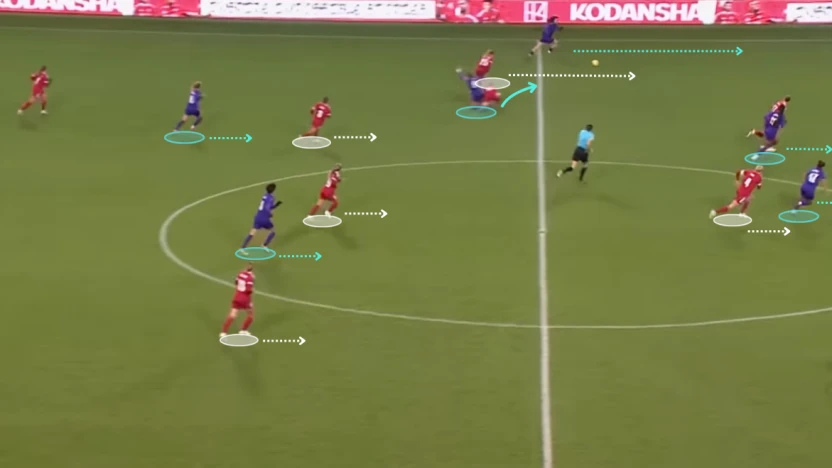
When the former Tenerife and Real Sociedad manager arrived in the capital, Spanish football journalist Marta Grinan noted that Maestre has “always advocated possession football, intelligent pressing and verticality when looking for goals.”
We see this in action as Allsani, playing as a left winger in a 4-2-3-1 shape instead of up front, finds Corrales on the overlap. As a result of Allsani’s deep and narrow position, with her teammates in midfield further behind her, Corrales becomes fairly isolated when she reaches the byline since Parris and Grace Geyoro made supporting runs into the penalty area.
Closed down fast, Corrales floats a cross in towards the lone striker Parris, who doesn’t have the height to beat Grace Fisk in the air. The chance ultimately petered out due to a foul, once enough Liverpool players managed to recover the space and outnumber London City inside the box.
Not only would the 0.17 xG for compared to 0.41 against have been alarming, given Maestre’s desire to control the game in terms of scoring chances, but also the fact that his team’s 17 touches inside the opposition’s box was just a single touch higher than when Prêcheur did battle against them before the winter break.
This, plus the average number of touches inside the other team’s penalty area falling from 22 to 17 per 90 in the 8 games before and after his hiring, hints at a side that is still getting to grips with the more narrow width that Maestre wants to play with.
The same pattern also emerged in the 2-1 win at Brighton, his first as Lionesses manager, registering just 6 touches in the opposition’s penalty area compared to 20 touches in last December’s clash - the same difference between each manager’s clash with West Ham.
However, unlike in their home game, London City Lionesses would benefit from an exciting young talent who they used to great effect against the Seagulls: Freya Godfrey.
Godfrey going against the grain
Much like her latest club, the 20-year-old has exploded onto the BWSL scene with 4 goals and 4 assists in 15 matches. She had a very quiet game in the first meeting with Brighton, amassing a mere 0.07 expected goals and assists. However, that changed with Maestre at the helm.
Narrow styles of play, like the vertical tiki-taka popularised by Spanish football, benefit from wingers known as inside forwards, players that are fast and technical enough to drive towards the byline for a cross or pass into the feet of a teammate or cut inside to try and score themselves. Godfrey has shown she is more than capable of fulfilling that role.
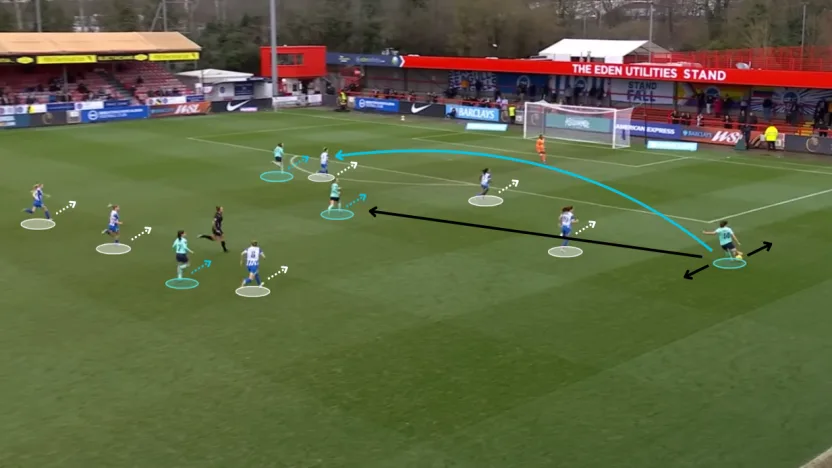
Here, Fernández drives through the middle and passes into the space in front of Godfrey. Instead of holding the ball up for more of her teammates to arrive, she spots the run of Goodwin at the backpost and sends in a teasing low cross that caused all kinds of concern. So much so that Moeka Minami felt she had to reach it first, inadvertently sending it into her own net.
Godfrey found herself in almost the same exact position just before putting Lionesses in front, striding confidently infield and past Dutch left back Maris Olislagers. She took four touches inside the box - putting this into context, 66% of her team’s total touches in that area - including the one that curled it brilliantly into the top left corner, making it 2-1.
No big chances all game? No problem, particularly for a player tipped to be one of England’s best wingers in not so many years from now.
It bore echoes of her powerful strike from inside the penalty area to equalise against Manchester City the week before, cutting inside from the top right and arrowing a powerful effort home - something that’s quickly becoming a signature move.
Not long before her winner in the Brighton game, during this attack, Godfrey also poses a threat off the ball by taking up a position alongside Goodwin six yards from goal. Had it not have been for a phenomenal sliding interception by Maisie Symonds tracking back from midfield, Godfrey was poised to sweep Corrales’ cross home.
What this demonstrates is that Maestre has synthesised each of their skillsets as a part of his vertical system, albeit far from often enough to win more games than what he has - save for Goodwin’s 0.64 xG opportunity from Godfrey’s ball right across the face of goal, after brilliant footwork to weave into the box from the left byline. A goal would have doubled their lead and bagged her second assist of the game.
But the three points weren’t lost in that missed big chance, rather a separate moment that came not long after that highlights an issue that Maestre should look to address in his defense: the disjointed manner with which his team has pressed.
Problems persisting in the forward press
Teams that focus on possession look to exact a high press onto their opponents to relinquish them of the ball and defend from the front, and London City Lionesses are no different.
Their total of 268 pressing sequences and 11 presses per defensive action (PPDA) rank fifth highest in the BWSL, highest of all top flight clubs outside the ‘big four’. The data is limited, though, as it merely shows Lionesses are active pressers, not how successful they are.
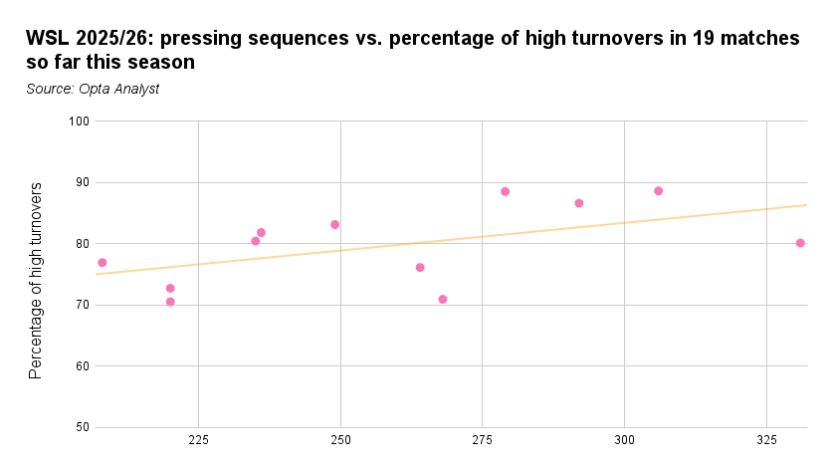
London City have achieved 190 turnovers from their presses so far this season. Taking into account the pressers to turnovers ratio, they rank second bottom with 70.9% leading to them winning the ball 40 metres or less from the opponent’s goal. This highlights a rather inefficient high press, despite how eager both Precheur and Maestre were to use it.
However, Lionesses still made the bold decision to take the game to sides in worse form, like West Ham and Liverpool, but subtle differences in Maestre’s execution cost them points.
In their 1-1 draw with West Ham, Lionesses conceded a quite spectacular volley from centre midfielder Oona Siren, after the visitors headed clear a free kick. Lionesses couldn’t have done much about it. The same can’t be said for how they conceded the set piece.
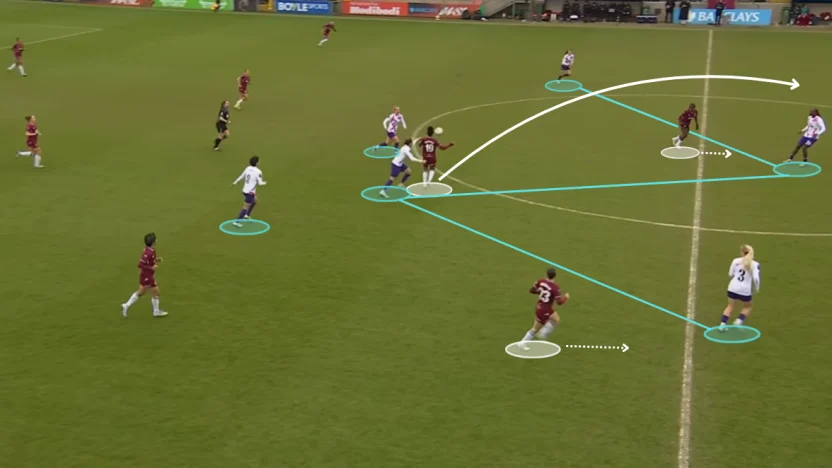
Elena Linari chooses to press Shikeira Martinez alone so she can contest for a high ball towards her from defence. Because the midfield is caught high as she misjudges the bounce, costing her position goalside of the German, her team is left short at the back.
It then takes one pass towards substitute Viviane Asseyi to put Wassa Sangaré and Poppy Pattison under pressure, with the former having no choice other than a professional foul. From that, Siren powered home her delightful looping strike after Goodwin heads the free kick away. The better choice for Linari would have been to let her midfielders close the space from behind, putting pressure on Martinez to shift the ball on.
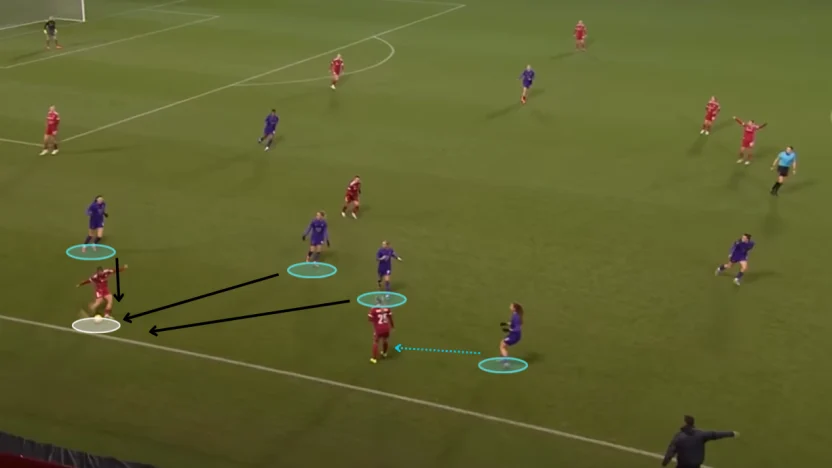
Here, Lionesses commit three players to a very high press on Liverpool’s left back position but instead make the opposite mistake to Linari and don’t enact the right press before a direct pass is then played over the midfield area.
They have made a habit of funnelling teams into their full-back positions this season, which would make sense as Corrales and Fernández are strong in tackle and are often found among the highest ranked players in terms ground duels won per 90.
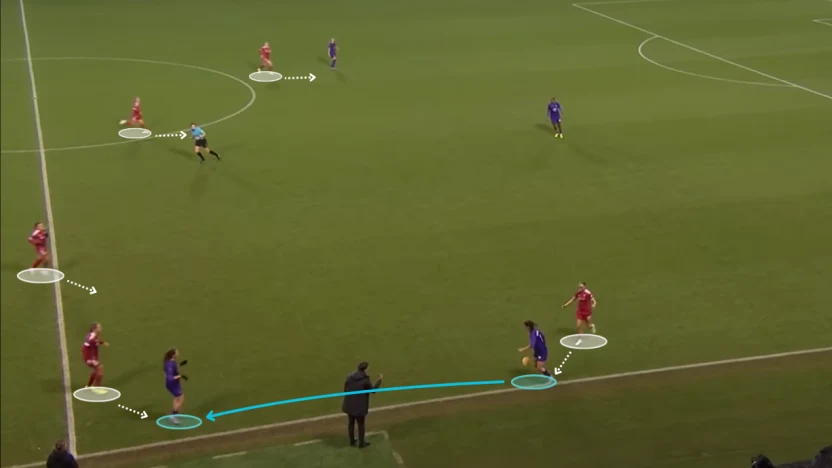
The ball is successfully recovered where the visitors wanted. But due to both defensive midfielders and central attacking midfielder in Maestre’s 4-2-3-1 being stranded in the attacking half, this limits the options for an outball to just one: down a culdesac.
Corrales is then closed down and dispossessed, and London City go close to conceding a goal from Ceri Holland following a swift counter by Liverpool, catching the visitors high.
Maestre’s Lionesses not moving around the pitch in units, as should happen between phases of play or when they anticipate this might happen, is evidently a recurring theme. We also saw it in the Brighton example, where Godfrey didn’t have much to aim for in the penalty area.
Although other factors likely contribute, this could be a root cause for the percentage of accurate passes falling from 82.3% to 77.8% since his hiring. It is yet another piece of the puzzle that Maestre needs to address to get his side playing and pressing more coherently.
Conclusion
All things considered, it’s been a tough period of learning for Eder Maestre in his first season in English football. There are several promising signs to his attacking play, the star shining brightest as part of his system being winger Freya Godfrey.
However, London City Lionesses took a bold risk bringing him in to replace Jocelyn Precheur, a widely respected figure in the women’s game who guided the team to their debut BWSL season.
With 6 points taken from a possible 24 and just one win against the same three opponents as Precheur during his final matches in charge, Maestre needs to prove his style is the right one by winning more fairly soon. Leicester, Tottenham, and Aston Villa in the final three matches of the season represent ample opportunity to do just that.
Word credit: Oliver Whitmore