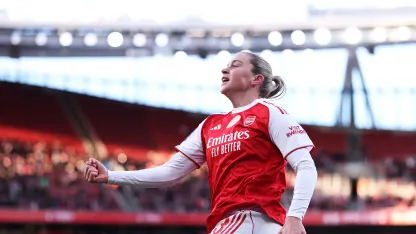
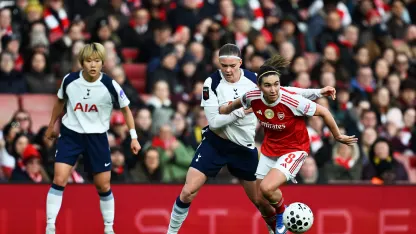
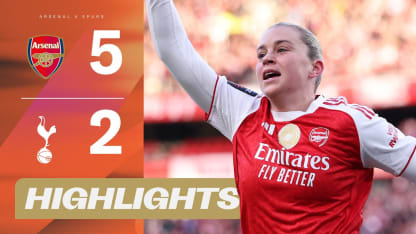
Heading into the North London derby at the Emirates, Arsenal arrived on a run of four consecutive wins, having kept clean sheets in each of their previous three outings and having conceded just once in their last five matches. The title looks set to head to the blue side of Manchester, but this was a chance for Arsenal to cement their place in the fight for second and underline their BWSL credentials.
Tottenham came into the game with mixed form, having registered one win in their last five, but that victory was a remarkable 7-3 win at Aston Villa, demonstrating their attacking threat when the game opened up. Three defeats in that run included a 5-2 loss at champions-elect Manchester City, and a narrow 1-2 home defeat to Everton that could easily have gone the other way. Their form has reflected a season of inconsistency; they are a side capable of real quality on their day, but currently look unable to sustain it with any regularity.
What derbies do, of course, though, is temporarily suspend all of that logic. Form, xG, tactical shape, none of it fully counts for anything in a fixture that means something beyond three points. Both teams knew that, and for long stretches of Saturday afternoon, the match played out with the level of intensity the occasion demanded.
Arsenal may have won 5-2, but the scoreline doesn’t tell the full story. This derby was settled by clinical finishing and some astute tactical decisions by Renée Slegers. In this analysis, we break down the tactical shape of both sides, examine how Arsenal constructed their goals and where Tottenham's defensive structure came undone.
Formations
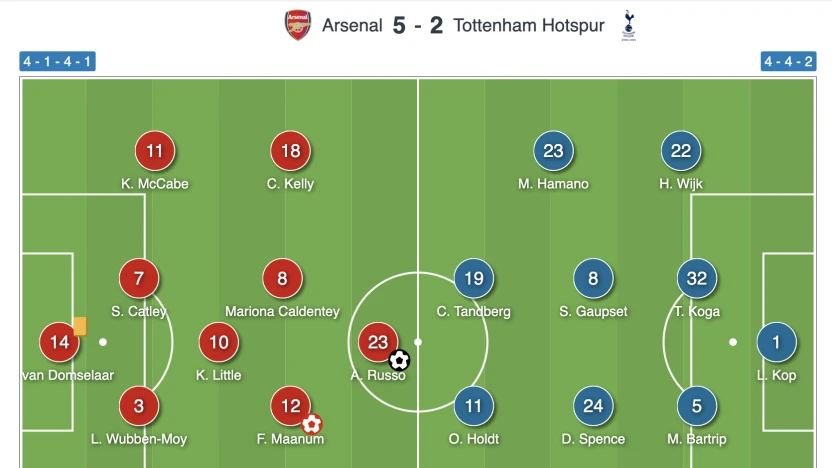
Renee Slegers opted for a tried-and-tested 4-3-3 system. Daphne van Domselaar returned to the line-up in goal. Recent addition Smilla Holmberg was given the nod at right-back, with Lotte Wubben-Moy and Steph Catley in the central defensive partnership and Katie McCabe at left-back.
Kim Little operated as the single pivot, shielding the back four and dictating the tempo from deep. Mariona Caldentey was given licence to roam in midfield, with Frida Maanum pushing up and operating more as a number ten.
In form, Chloe Kelly and Olivia Smith offered pace and trickery out wide while Alessia Russo led the line as the central striker. The shape was designed to compress the middle of the pitch and transition quickly, with Russo, Smith and Kelly’s movement exploiting spaces and Caldentey's creativity as the primary attacking outlets.
Martin Ho set Tottenham up in a 4-4-2, opting for a more structured approach. Liza Kop started in goal behind a back four of Hannah Wijk, Toko Koga, Molly Bartrip and Amanda Nildén. The midfield consisted of talented youngsters Maika Hamano and Signe Gaupset, paired with the experienced Drew Spence and the versatile Matilda Vinberg. Olivia Holdt and Cathinka Tandberg formed the front two.
The 4-4-2 gave Spurs a compact defensive shape in two disciplined banks of four and, in theory, offered the width and directness to test Arsenal on the counter.
Arsenal's lineup carried the weight of experience; most of the Gunners' squad are seasoned internationals with major tournament experience. Tottenham, by contrast, have leaned heavily on youth this season, with the likes of Hamano, Gaupset and Tandberg representing a generation still finding their feet at the top level of the domestic game. Ho's project at Spurs is very much built on potential, while for Slegers and Arsenal, the priority is winning trophies now.
Playing through the press
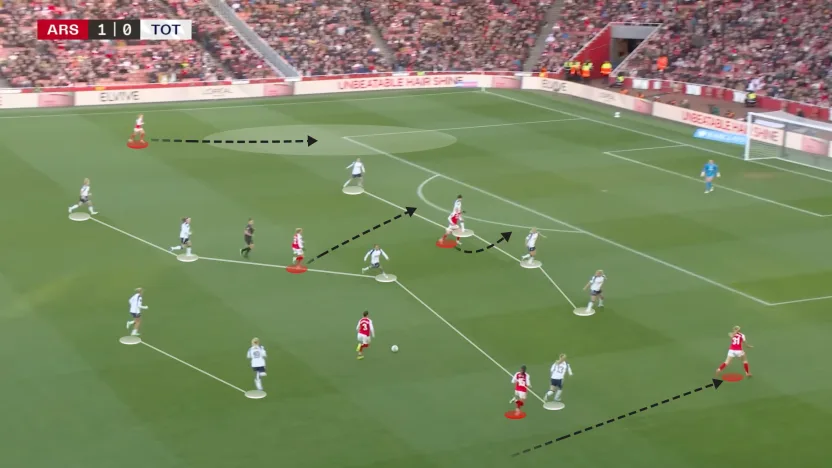
Tottenham arrived with a clear defensive plan, sitting in a compact shape and looking to press in organised banks rather than commit individuals to a chase. The intention behind this was to limit Arsenal's ability to play through the lines and force them into mistakes in the build-up phase.
However, right from the off, Arsenal's off-the-ball created problems that the Spurs structure was not quite equipped to solve. Anticipating Tottenham looking to close off central passing lanes, Slegers had clearly instructed her side to make the pitch as wide as possible.
Here, we see a moment that encapsulates much of Arsenal's approach in the first half. Wubben-Moy is carrying the ball forward with purpose into the Spurs half, and Tottenham's 4-4-2 shape is already beginning to show its vulnerabilities. Holmberg is high and wide on the right, Kelly mirroring her on the left, and together they are stretching the Spurs defensive block horizontally.
Consequently, the Tottenham full-backs are caught in two minds - unsure whether to hold their shape and leave Arsenal's wide players acres of space, or press out and risk leaving gaps behind for Russo to exploit.
This is exactly the dilemma Slegers had designed into Arsenal’s attacking structure. Russo is making a run in behind, as she almost always is, and Maanum is deliberately holding her position just outside the Tottenham midfield line.
If the defensive line drops to track Russo, Maanum can move into space with time to play. If they hold and let Russo run, the ball goes in behind. This is a simple idea executed with real intelligence, and it is the kind of movement that Tottenham struggled to account for throughout the game.
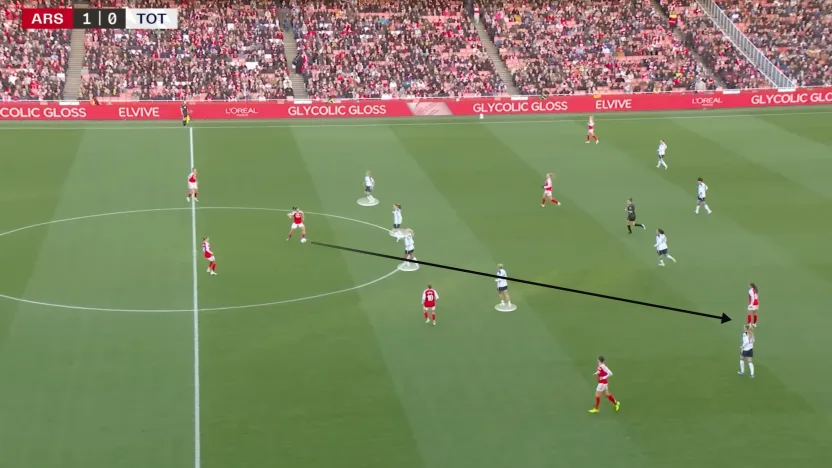
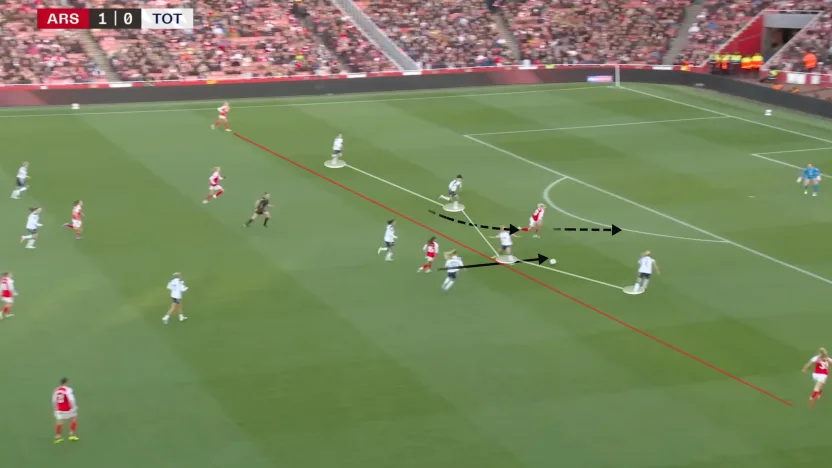
After taking the lead through a set piece, Arsenal's second goal demonstrated exactly what Tottenham had been unable to prevent throughout the opening period. Signe Gaupset is drawn out of her midfield block as Spurs attempt to limit the space afforded to Mariona Caldentey, but the Spanish World Cup winner is never put under enough pressure to force the error Ho's side needed. Gaupset vacating her position leaves Drew Spence with an enormous amount of ground to cover and, crucially, a gap through the centre of the park that Arsenal are already moving to exploit.
Caldentey, given the half-second of time that players of her quality rarely need more than, fires a pass into the feet of Olivia Smith. She turns and drives forward through the centre, Holmberg and Kelly hold their width on either flank, causing a moment of indecision for the Tottenham full-backs and preventing them from fully tucking in to cover. Russo makes her run in behind, Smith finds her, and the England international does the rest.
The move was a microcosm of Arsenal's attacking intelligence in this game. Gaupset's decision to press Caldentey is understandable in isolation, but it unravels Tottenham's defensive structure, allowing their rivals to play through them.
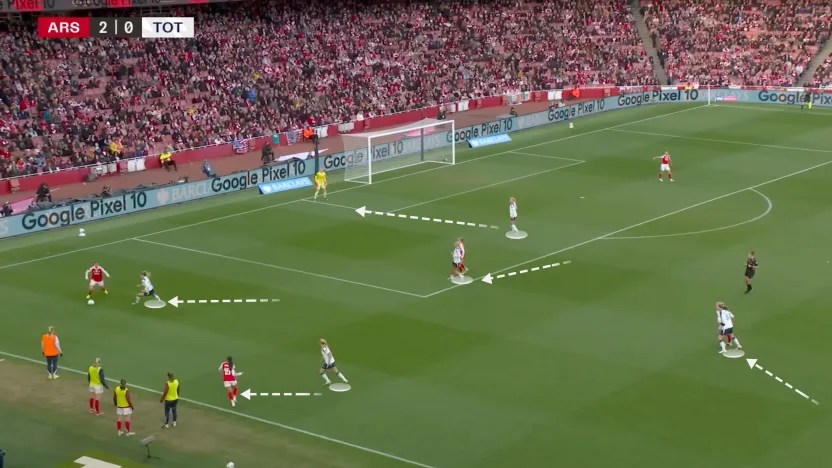
Tottenham's PPDA of 10.17 indicates they came to the Emirates with a clear intention to press and deny Arsenal time on the ball when possible.
Moreover, there were moments, particularly in the first half, when they caused the Gunners problems when playing out from the back. Martin Ho's side engaged in an active, player-oriented press, looking to force Arsenal backwards. Here, we can see Wubben-Moy under significant pressure, with her passing options quickly closed down.
When Spurs did recover possession in advanced areas, the intention was clear - get the ball into the box quickly and test an Arsenal backline that had kept three consecutive clean sheets heading into the match. Unfortunately for Tottenham, they were unable to make the most of these moments.
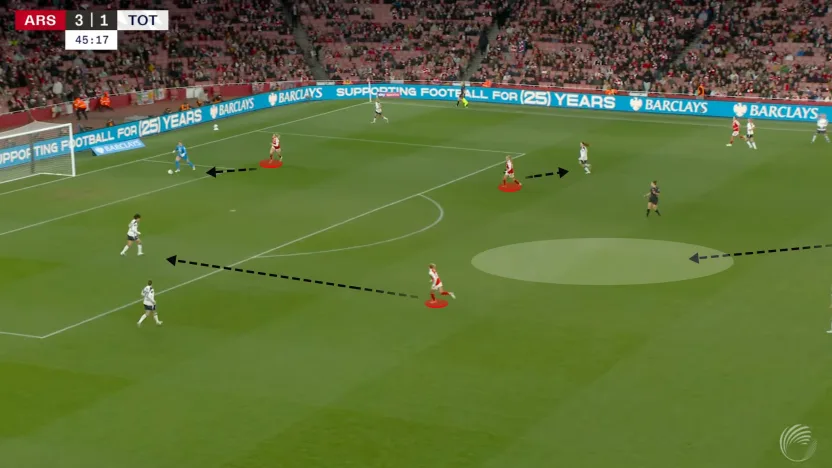
By contrast, Arsenal's PPDA of 13.15 confirms that Slegers was not asking her side to press with relentless intensity. They weren’t looking to suffocate Tottenham high up the pitch. Instead, the approach was more considered, utilising a structured, selective press designed to force errors in specific areas rather than chase the ball all over the pitch.
In this example, the pass back to the goalkeeper acts as the trigger for the Arsenal press. Russo moves to close down immediately, while Kelly and Maanum work to seal off the available passing lanes, limiting the defenders' options in possession.
Caldentey, meanwhile, positions herself optimally to recover the ball should the press force the error. It is a coordinated, intelligent press where each player has a specific role, the collective movement designed to compress space and leave Tottenham's goalkeeper with nowhere comfortable to play. This is why, of Arsenal’s 80 recoveries, 16 came in the attacking third, nearly double Spurs' nine.
Wide combinations
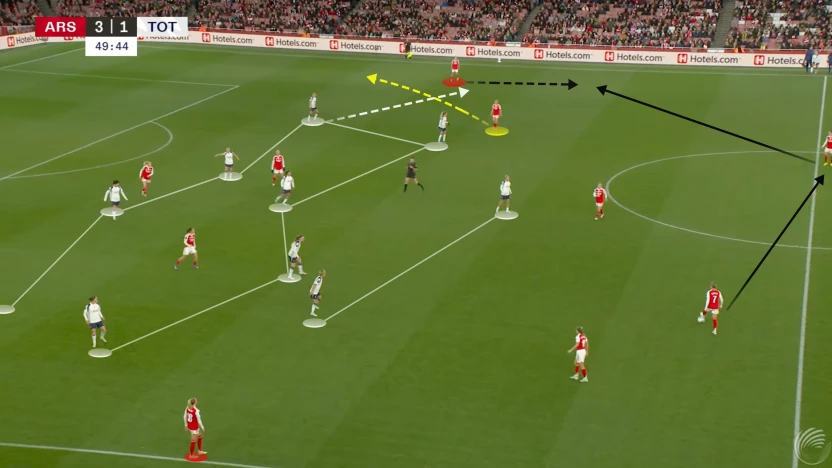
Arsenal used wide combinations to manipulate the Tottenham defensive structure with real purpose. Here, we can see that with Spurs pushed over to their left, space opens up on the right flank, and this is where Slegers' side repeatedly found their most productive avenue.
Caldentey and Maanum position themselves deliberately between the defensive and midfield lines, giving Tottenham's shape two problems to solve simultaneously - they either track the runners or hold the block.
Freshly returned from the Asia Cup, Caitlin Foord operates wide on the right, with Holmberg tucking into the inside channel alongside her. The movement is mirrored on the left by McCabe and Kelly, stretching Tottenham horizontally across the pitch and making their two banks of four increasingly difficult to maintain.
When Foord drops deeper to receive the ball, she drags Nildén with her, and the space that creates down the flank is exactly what Holmberg is looking to exploit. The Swede makes the run, receives, and finds herself in an optimal crossing position.
What this does is force Tottenham into an impossible decision at full-back. Nildén, following Foord, means Holmberg is free to run in behind, if she holds and lets Foord receive, Arsenal have technically gifted players in Mariona and Maanum, in space to receive between the lines.
Holmberg completed four passes into the final third and registered an assist directly from this type of combination, underlining how effectively Arsenal weaponised her overlap. For a side defending in two disciplined banks of four, being stretched both vertically and horizontally by the movement of this quality proved too difficult for Tottenham to deal with.
Spurs’ moments of promise
Whilst this was an extremely dominant and clinical performance from the hosts, there were moments where Martin Ho's Spurs gave them genuine cause for concern, particularly in the second half as the game opened up and the spaces Arsenal had been so disciplined in denying began to appear.
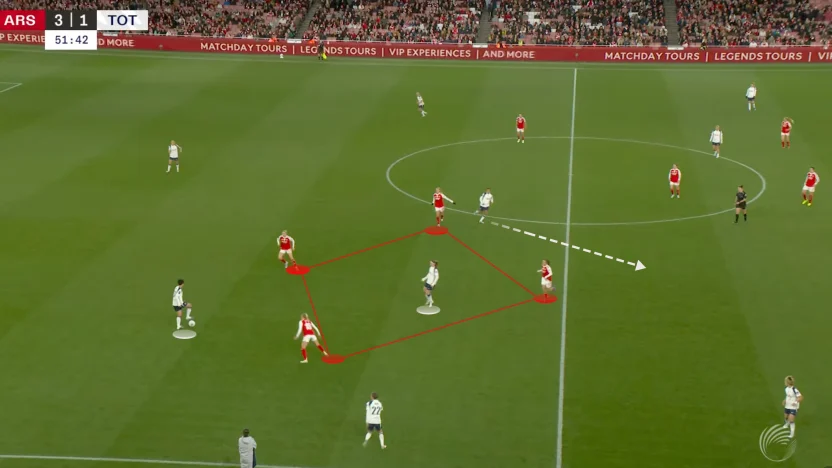
Here, we can see Gaupset move to receive the ball in a pocket of space, surrounded by Arsenal players. Her movement draws both Maanum and Caldentey towards her, which, in turn, frees space for Drew Spence to move into. Additionally, Wijk provides a potential passing outlet for Gaupset should she receive the ball, enabling Tottenham to move the ball quickly and efficiently.
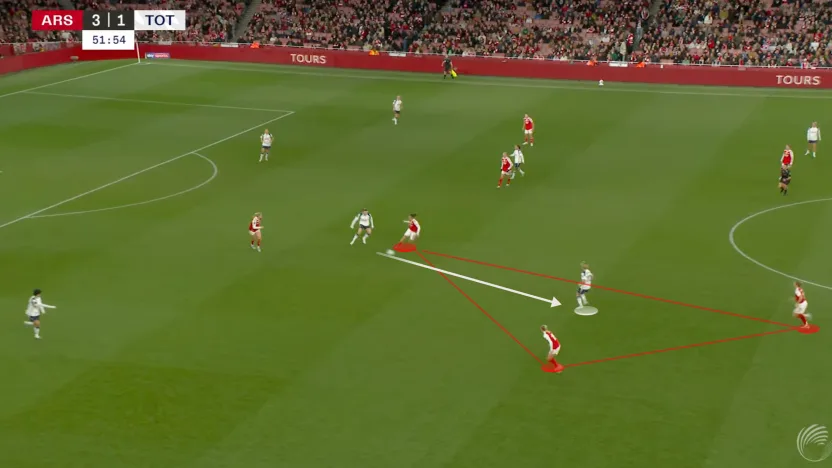
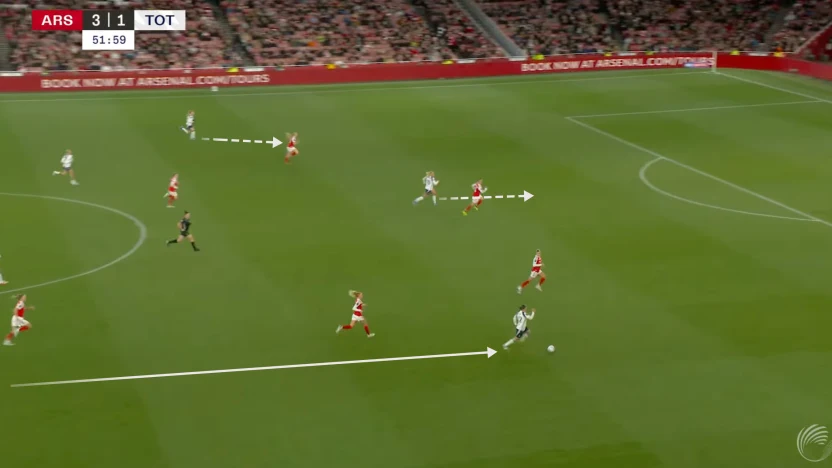
Following the same sequence, Tottenham recycle possession and look to go again. Gaupset receives, turns, and plays into Hamano, who has dropped intelligently into the space between the Arsenal lines.
The pass takes Caldentey out of the picture entirely, and Hamano's movement has done its work by dragging Kelly across and pulling McCabe forward to press, leaving space opening up on the Tottenham right for Wijk to exploit.
Hamano spins away from both Kelly and McCabe and plays a wonderful ball for Wijk, who is free to run into the space vacated by McCabe. This is the kind of sequence Ho's side were capable of in their better moments, and it illustrates why Tottenham's 76 progressive passes were not simply a flattering statistic.
They could move the ball forward with real quality when the spaces appeared, and when they did, Arsenal's defensive structure was not always as secure as the final scoreline might suggest. On this occasion, Spurs get players forward and generate a shot at goal. Despite the dominant narrative of the afternoon for Arsenal, there were some real moments of vulnerability that a more clinical Tottenham side might have punished.
Conclusion
Arsenal's 5-2 victory reflected their quality without fully capturing the complexity of the contest. Slegers' side were clinical, tactically disciplined, and ultimately too good for a Tottenham side who, on another day, might have made this considerably more uncomfortable.
It has to be said, Tottenham were not without merit. They had moments of genuine attacking threat through intelligent off-the-ball movement and a willingness to work for one another.
For Arsenal, this win was another statement of intent in a season building towards something. Four consecutive wins, a settled system, and a cutting edge that is proving difficult for opponents to contain.
Meanwhile, for Tottenham, it's clear there are foundations to build despite a result that will sting. Ho's side showed enough in moments to suggest the potential is there. The challenge now is to convert those moments into something more sustained over the course of a season.