
On paper, this was supposed to be the Barclays WSL's biggest test of the season, the reigning champions against the champions-elect, a title-defining clash at the Etihad.
In reality, Andrée Jeglertz’s team made quite the statement. Kerolin's clinical hat-trick, sandwiched between goals from Khadija Shaw and Vivianne Miedema, ensured City took all three points against a Chelsea side who found it difficult to establish their rhythm in the game.
Sonia Bompastor's decision to match her opponents in the middle of the park and deploy a 4-3-3 formation didn’t quite have the desired effect, as it allowed Yui Hasegawa to control the midfield battle with the kind of composed authority we’ve come to expect from the Japanese international.
The Blues actually enjoyed more possession (54%) but created few high-quality opportunities, as City’s compact shape proved highly effective at limiting space in central areas.
Alyssa Thompson managed to pull one back in the 68th minute, but the contest was long over. City knew exactly how to hurt their opponents. They turned transitions into devastating attacks and utilised their set-piece expertise just as they have all season.
By full-time, Chelsea had slipped to third in the table, and City’s lead at the top had stretched to 11 points. This was a statement victory by Jeglertz and his team.
In this tactical analysis, we'll break down how Manchester City controlled the match's tempo and played to their strengths, whilst examining the tactical questions within Chelsea's system in both defensive and attacking phases.
Line Ups and Formations
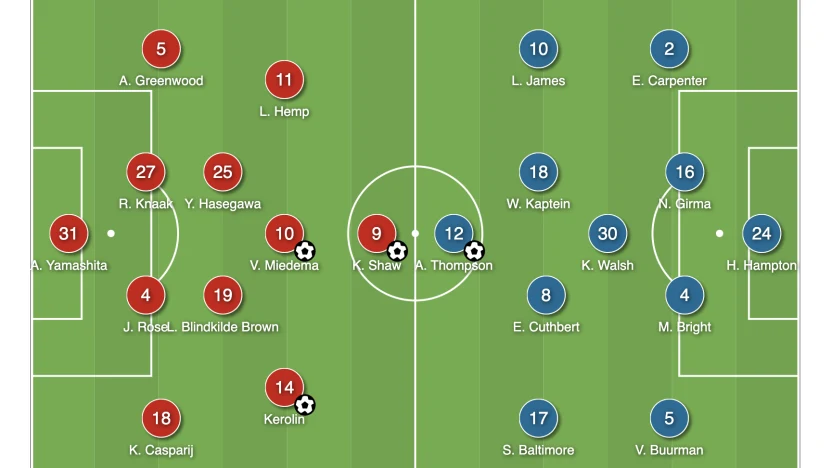
With this game touted as the ‘title-decider’, it’s no real surprise that Andrée Jeglertz opted to field a tried-and-tested formation. His Manchester City team lined up in their usual 4-2-3-1 system, looking to utilise their speed out wide with Kerolin and Lauren Hemp.
The defensive line consisted of Casparij, Rose, Knaak, and Greenwood, with Hasegawa and Blinkilde Brown forming a double pivot in front of them. Miedema operated as the number ten, dropping deep to create overloads and link play between midfield and attack.
Chelsea's setup featured a back four of Carpenter, Girma, Bright and Buurman shielded by a midfield trio of Kaptein, Walsh, and Cuthbert. The front three of James, Thompson, and Baltimore were tasked with stretching City's defence and providing width in the attacking phase.
Bompastor’s aim here was most likely to control possession and limit City’s ability to build up. Before this match, the Citizens averaged 57.37% possession per 90, so, understandably, the Chelsea manager wanted her team to control the ball and, in theory, give them more control over the flow of the game.
However, as the game progressed, it became clear that Jeglertz had anticipated Chelsea's approach, and his team were more than happy to concede possession. They were compact defensively, closing off passing lanes and forcing Chelsea into predictable patterns before springing devastating counter-attacks.
Additionally, City's pressing was remarkably disciplined. Instead of being lured out of shape by Chelsea's possession recycling, they waited for optimal triggers. This was typically when the ball reached the midfield three.
Then, when they did press, they went as a cohesive unit. Their collective approach forced errors from Chelsea's midfield and backline, allowing Manchester City to win the ball in dangerous areas and transition quickly into attack, which ultimately helped them win the game.
The City Press
With an average PPDA (passes allowed per defensive action) of 8.77 per 90, City came into this game as the most intense pressing team in the league, meaning they allow opponents fewer passes before engaging in defensive action. However, in this game, City recorded a PPDA of 18.73 - more than double their season average. This stark difference tells us a lot about their game plan; the press wasn’t relentless; it was much more structured and considered.
Jeglertz realised that asking his team to chase possession in their final third would create the spaces that Bompastor’s side constantly seek to exploit. Waiting for the right moment to engage was key for the City press.
Furthermore, with the notable absence of Lucy Bronze, Chelsea were missing the player who averages the most progressive passes per 90 in the league, at 15.5. It is worth noting that Naomi Girma ranks second in the league for this metric, averaging 13.08 per 90. Still, City’s astute defensive positioning meant the U.S. international couldn’t influence her team’s ball progression as she usually does.
The key to neutralising Chelsea lay with Shaw and Miedema. When Chelsea were looking to build from the back, the former ensured that the passing lane from Hampton to Girma was unavailable.
Simultaneously, Miedema stuck to Walsh like glue when City were in their out-of-possession structure. This coordinated pressing often forced Chelsea to build down their left side, where Kerolin and Casparij were always ready to put their opponents under pressure. Bronze’s absence, coupled with Girma and Walsh’s isolation, funnelled Chelsea's ball progression exactly where City wanted it.

This patient but effective pressing structure created turnovers in dangerous areas that City could exploit immediately. The hosts' second goal perfectly demonstrated how their defensive positioning and midfield pressure could trigger devastating counter-attacks.
We can see here as Chelsea are looking to build from the back, the City front line is waiting, identifying the optimal time to engage. Bright is on the ball with Kerolin bearing down on her, Shaw is positioned to close off the passing lane to chief ball progressor Girma, whilst Miedma is ready to intercept any pass to Walsh. The Blues’ passing options are systematically limited here.
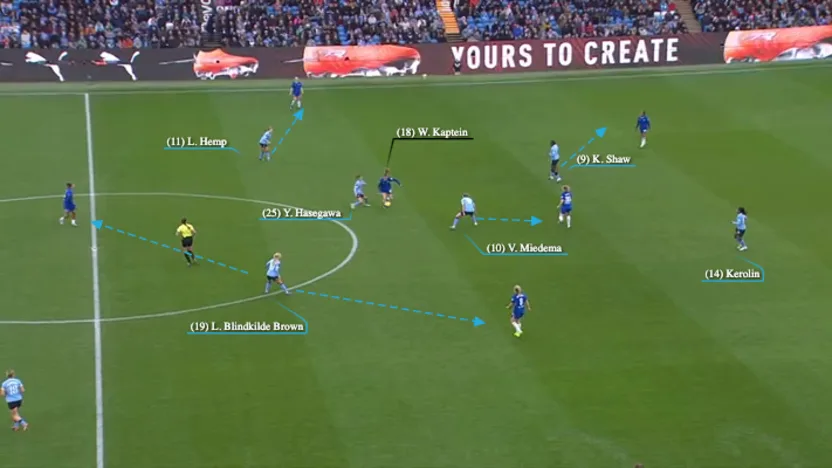
Having already tried and failed to build down the left on several occasions by this point, Bright opts for the risky pass into Kaptein. The 20-year-old does well initially to bring the ball under her control, but she’s immediately met with intense pressure from Yui Hasegawa. The Japanese orchestrator marshalled the City midfield with immense calmness and leadership, making 16 recoveries - the most of any City player.
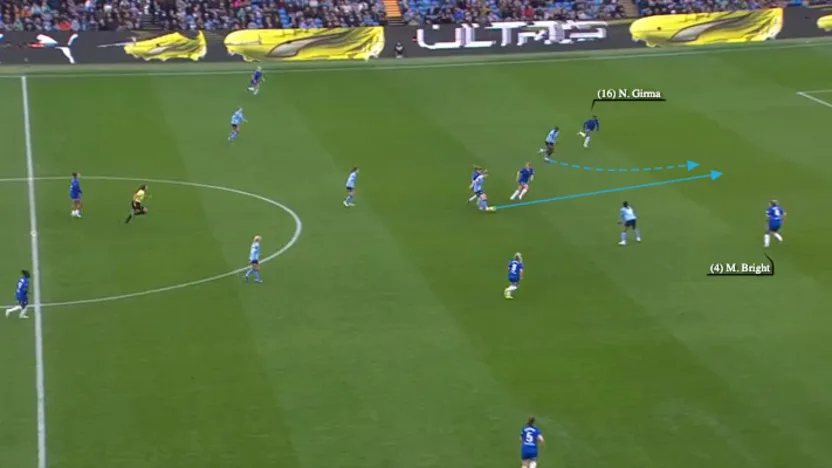
The positioning of City's players means Kaptein has nowhere to turn. Any pass she attempts will likely be intercepted, and any forward pass will be blocked. This forces her to hold onto the ball for a fraction too long, allowing Hasegawa to dispossess her cleanly in the Chelsea half.
From there, it’s a simple pass into Miedema who immediately spots the run of Shaw, in behind Chelsea’s high defensive line. The former Arsenal player hits a perfectly weighted ball into the path of the Jamaican international. One-on-one with Hampton, Bunny Shaw slots it home to make it 2-0.
As a result, City’s second was a goal born out of intelligent pressing and positioning.
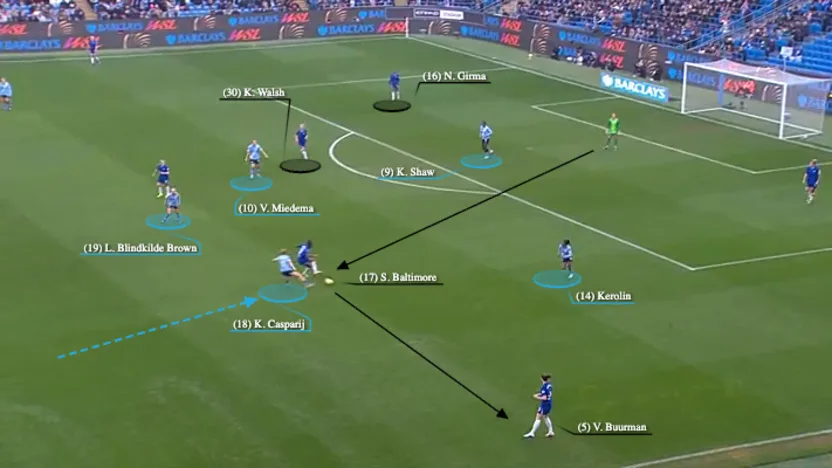
However, it has to be said that Chelsea were very aware of City’s game plan. In the early stages, in particular, they were able to drag Jeglertz’s team out of position through positional rotations and off-the-ball movement, creating the spaces they often like to utilise in build-up play. Here, we can see Miedema marking Walsh whilst Shaw closes the passing lane to Girma.
Baltimore makes an intelligent run back into space to receive the ball, dragging Casparij with her. The Dutch defender does well in terms of not letting Chelsea’s left winger turn away from her, but with Buurman available, it’s a simple pass out to her to retain possession.
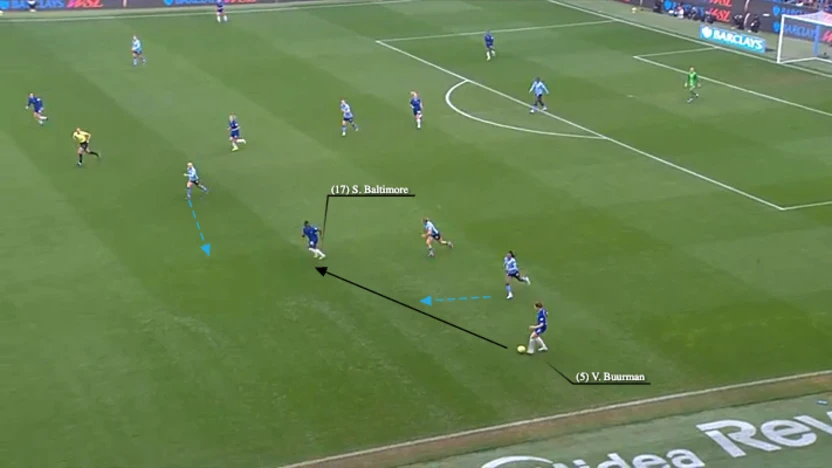
Following the same sequence, Buurman plays the ball back to Baltimore, but Kerolin and Casparij's recovery halts the Chelsea attack before it can even begin.
Moreover, when Chelsea did successfully play through the press, they often seemed reluctant to commit runners forward. The Blues’ hesitancy in possession consistently allowed City to recover, backtracking into a defensive shape where they could outnumber their opponents.
Limiting the Space
As mentioned above, City didn’t dominate possession or press aggressively in this game; they were more than happy to let Chelsea maintain possession in non-threatening areas. The statistics reflect this; in the first half, the Blues enjoyed 67% possession and completed significantly more passes than the hosts, but were unable to turn this into clear-cut goal-scoring opportunities.
When Bompastor’s side did progress the ball into the final third, City consistently ensured they were in their defensive shape with the sole intention of frustrating Chelsea, denying them any sort of space in central areas.
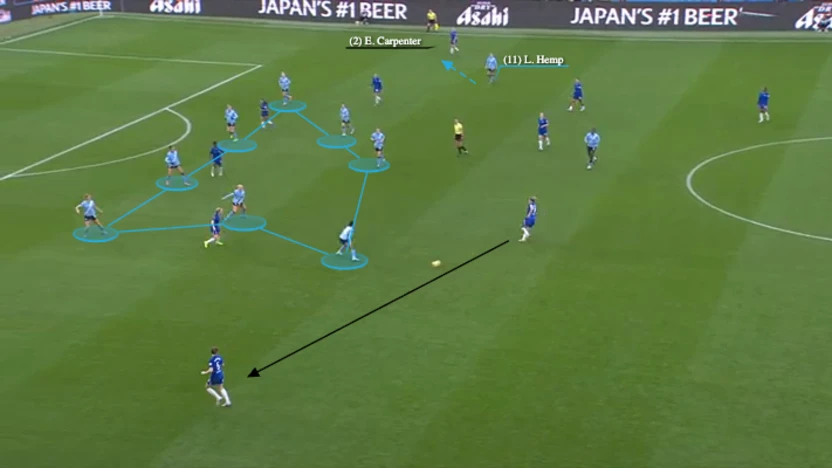
Here, we can see the full extent of City’s compactness. The back four are all maintaining close distances from each other, operating within a narrow horizontal channel. Hasegawa and Blinkilde-Brown sit just in front of them, screening the space between the defensive and midfield lines, while Miedema and Kerolin tuck in to close the space in central areas.
Eight Manchester City players are condensed into a tight defensive block, limiting Chelsea’s ability to play penetrating passes through the lines. In this instance, Mille Bright has no option other than to play the ball to Buurman out on the left.
Lauren Hemp was clearly tasked with marking Ellie Carpenter rather than tucking in or forming a front two with Bunny Shaw. Hemp is one of the few players in the BWSL capable of matching the Australian for pace.
We can see the Chelsea full back high and wide on the right, but Hemp’s proximity to her ensures that Carpenter cannot receive the ball in a dangerous area and fully utilise her attacking qualities.
The limited central space left the reigning champions with few viable options. They could either attempt the risky passes through the lines, knowing there was a high probability of a light blue shirt making an interception or play safe passes out to the left, where the likes of Kerolin and Casparij could engage in favourable 1v1 duels. The City defensive shape meant Chelsea were able to control the ball but were limited in what they could do with it.
Over the course of the game, Chelsea created opportunities, generating 16 shots and finishing with 1.46 expected goals. However, City's compactness forced many of these attempts from long distances or low-quality positions. City, by contrast, generated 4.38 xG with less of the ball and fewer touches in the opposition box.
Flexible Build-up Play
Under Jeglertz, Manchester City have become synonymous with vertical passing and rapid ball progression through short, controlled sequences. During their moments of sustained possession, the Citizens still sought to utilise this.
However, in this game, they were much more adaptable in their buildup play, seeking to take advantage of Chelsea’s higher defensive line. Over the course of the season, Jeglertz’s team have averaged 502 passes per 90 with 8.35% classed as ' long passes’. Against Chelsea, that number rose to 10.22%. Whilst this is not a huge increase, it does show a clear shift in their strategy.
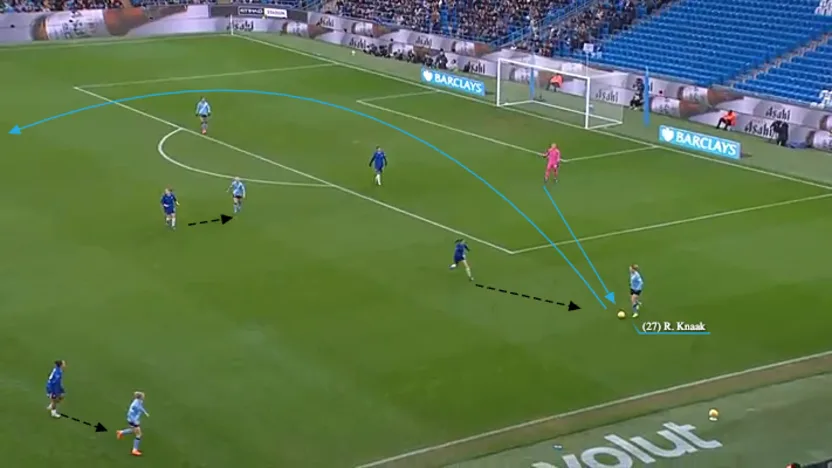
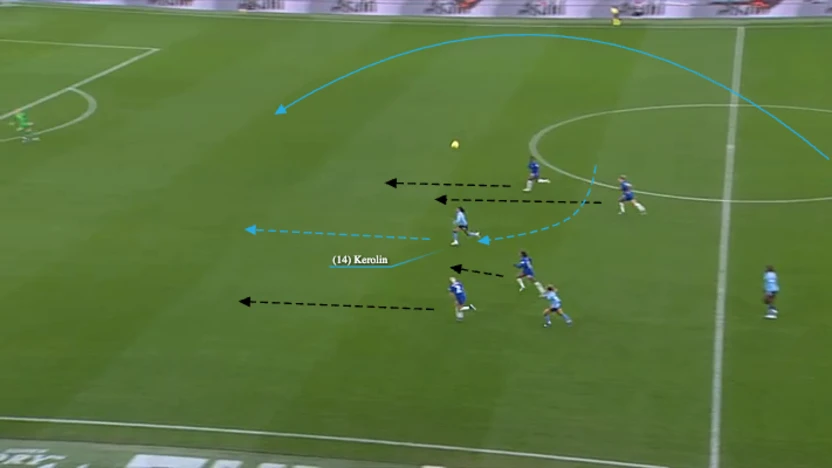
They recognised that Chelsea's press could be bypassed entirely by well-timed long balls over the top, eliminating the need to play through multiple lines and instead targeting the space behind their defensive line. Of course, this became more apparent in the second half as the six-time BWSL champions chased the game and therefore pressed further up the pitch to recover possession in dangerous areas.
This example encapsulates this approach. Rebecca Knaak uses her extensive passing range to bypass Chelsea’s press, launching a ball into the channel, allowing Kerolin to run in behind. The pass eliminates six Chelsea players in an instant and exploits the vast amount of space behind the back four.
The brilliance of this lies in its psychological impact. Even when Knaak's pass doesn't reach Kerolin's feet, Chelsea are forced to turn and sprint backwards to recover.
The constant backward movement prevented them from establishing their usual attacking rhythm or sustained pressure. Every time they pushed forward, they immediately had to defend their penalty area. It relieved pressure on City's defence, allowing Jeglertz's side to push higher up the pitch to disrupt their opponent’s build-up play.
Throughout the second half, Chelsea were constantly caught between two unpalatable options, they could either drop deeper and surrender territory, or maintain their high line and risk being caught out by City's direct passing. This tactical instruction from the Manchester City manager ensured his team took maximum points at the Etihad.
Conclusion
Manchester City’s victory over Chelsea was largely down to a well-considered and almost flawlessly executed game plan from Andree Jeglertz. The Swede set up his team to identify flaws in their opponents' approach.
Their intelligent defensive positioning and ruthless counterattacks limited Chelsea’s attacking influence throughout the game, something we are rarely used to seeing from Bompastor’s side.
Chelsea's system created some attacking opportunities, but they were vulnerable in transition and couldn’t find the answers to City's swift counterattacks or set-piece routines.
With an 11-point cushion at the summit, Manchester City are very much champions-elect. On this evidence, nobody is catching them.
Source: All references to data and photography has been taken from Wyscout.