
Liverpool spent the first three months of the season staring relegation in the face. Twelve games played, zero wins, and a spot in the relegation zone that was beginning to feel increasingly permanent as the weeks rolled by. Gareth Taylor had been brought in to implement his possession-based style, but his tenure was becoming more about survival than ambition.
The summer didn’t help. Olivia Smith, last season's top scorer with seven goals and Liverpool's main attacking threat, left for Arsenal. Taylor Hinds, their first-choice left-back and captain, also made the move to North London. To be fair to Gareth Taylor, this meant the former Manchester City manager inherited a squad that was objectively weaker on paper than the team that finished 7th in the WSL and reached the FA Cup semi-finals in the previous campaign.
Fast forward to February, and the picture is starting to look different. Back-to-back wins and two clean sheets have seen Taylor’s side climb out of the relegation zone. Liverpool aren't safe yet, not by any stretch, but momentum has shifted. Watching them, it is clear that the most precious commodity in any relegation battle, belief, seems to have returned.
The January transfer window has allowed The Reds to bring in some much-needed reinforcements, but there have been no panic buys. Every player through the door has clearly been brought in to make the team better.
For his part, Taylor hasn’t wavered from his preferred style of play, but there have been subtle changes in how Liverpool attack and defend, which have led to an upturn in their form.
In this analysis, we'll break down the tactical adjustments that have allowed Liverpool to climb away from danger, examining what has changed in their attacking structure and defensive organisation. Additionally, we will assess the impact of some of their new recruits and whether this turnaround has the substance to last through the run-in.
Gareth Taylor’s tactics
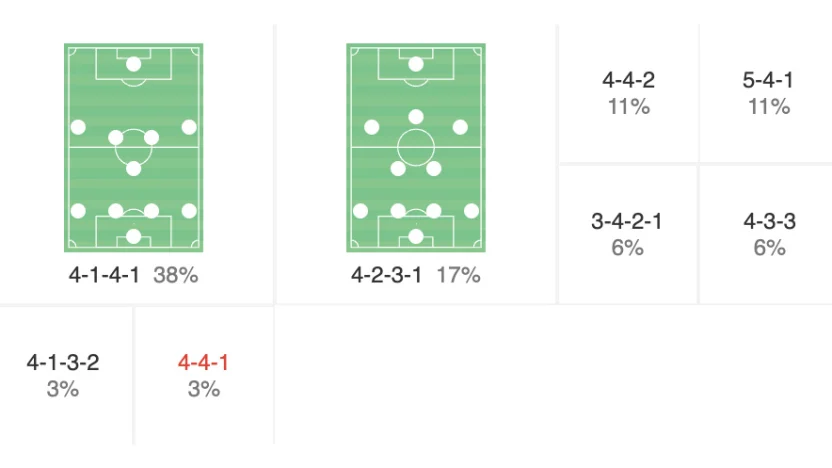
As shown in the graphic above, Taylor has primarily used a 4-1-4-1 (basically a 4-3-3) or a 4-2-3-1 formation this season.
His style at City was personified by high possession numbers, asking his team to build from the edge of their own penalty area and progress the ball out wide. Watching Manchester City during Taylor’s tenure could be frustrating at times, as they often enjoyed the majority of possession but struggled to create opportunities.
Upon arriving in Liverpool, it was expected that Gareth Taylor would bring his possession-dominant style, or at least a version of it.
Liverpool have averaged 47.98% possession this season, with a pass accuracy of 81.5%, so it’s fair to say Taylor is trying to impart his tactical identity onto the team, whilst perhaps accepting that they won’t always be able to dominate the ball.
The numbers indicate a pragmatic adaptation rather than a dogmatic insistence on his City blueprint. Liverpool attempted 65.4 progressive passes per game and 46.4 passes into the final third, indicating an intent to build methodically whilst recognising the limitations of their current squad.
It appears that Taylor has retained the principles of his possession-based philosophy while adapting the execution to suit Liverpool's personnel.
How do you replace a player like Olivia Smith?
Short answer: you can’t. At least, not directly.
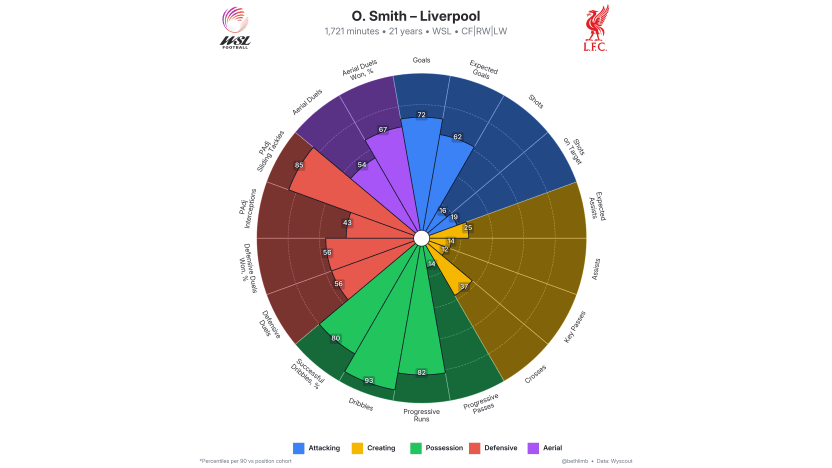
The Canadian scored seven BWSL goals for Liverpool last season, making her their top scorer and standout performer. The pizza chart above gives us further insight into how influential Smith was for the Reds.
Her goal output ranked her in the 72nd percentile for goals per 90. Interestingly, she was in the 16th percentile for shots per 90 and 19th for shots on target, suggesting she was extremely clinical in front of goal and found the back of the net on lower-percentage opportunities.
Moreover, she averaged 3.24 touches in the penalty area per 90 minutes, completed 5.39 dribbles per match, and carried the ball forward with purpose, averaging 2.67 progressive runs per game.
Smith was Liverpool’s primary creative outlet; she added a level of dynamism to Liverpool in the final third, which was always going to be difficult to replace.
In their opening twelve games this season, Liverpool managed just 10.8 touches in the penalty area per 90 as a team. Smith alone had averaged nearly a third of that output as an individual player. Whilst we have to consider that Liverpool had a different tactical style last season, first under Matt Beard and then Amber Whiteley, it is clear to see that Smith’s departure left a creative gap in the team.
Without her ability to beat defenders, drive into dangerous areas, and create space for others, Liverpool lacked attacking intent, indicating a team struggling to create goal-scoring opportunities.
There is no saying a player like Smith would have thrived in Taylor's heavily structured, pass-oriented system, but her ability to move the ball up the field was a big loss for Liverpool in the first half of the season.
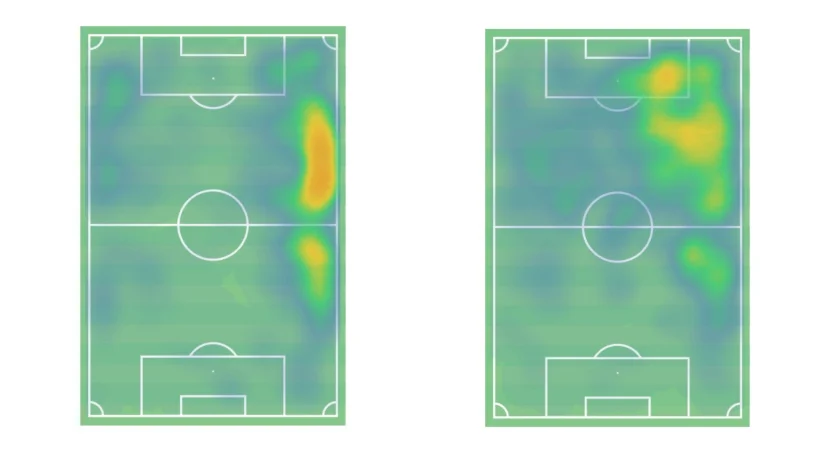
Here, we can see Ceri Holland’s heat map (on the left) from the current WSL season and Olivia Smith’s (right) heatmap from last season. The most noticeable difference is that Holland is operating more as a traditional winger, compared to Smith’s tendency to make inverted runs into the box.
As mentioned previously, this is typical of Gareth Taylor’s tactical setup: he generally asks his wide players to put crosses into the penalty area for a central striker. Holland is performing well in this role, averaging 4.41 dribbles per 90, 3.47 progressive runs, and 2.68 passes into the penalty area. She also averages 3.15 crosses per 90, but only 30% reach their intended target.
The biggest issue, though, has been the lack of creativity coming from the wide areas. Prior to this weekend’s game against Aston Villa, the Welsh international had just one assist to her name, from an xA of 2.34, it has to be said, indicating teammates were not always putting away the opportunities she created.
Similarly, Cornelia Kapocs has had limited influence when deployed on the left side, meaning that during the first half of the season, when Liverpool did get the ball into the wide areas, they struggled to get it into the box for teammates.
One player has already made a big impact in terms of changing her team’s attacking fortunes: Alice Bergström.
The 23-year-old Swede is one of Liverpool's new recruits, and in just five appearances, she has put in some hugely impressive performances.
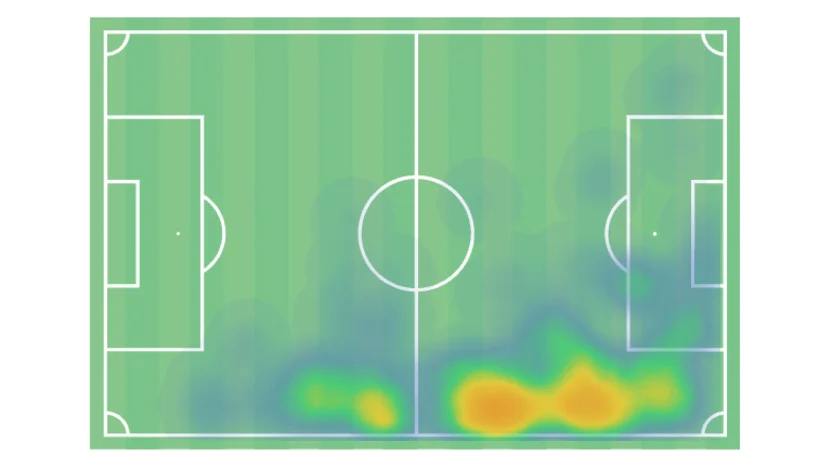
If Smith operated as an inverted winger, cutting inside from the right flank with her activity concentrated in the half-space and penalty area, and Holland, by contrast, acts as a traditional winger, Bergström's profile sits somewhere between the two. Capable of playing as a right-back or as a right winger, she presents a more dynamic attacking presence.
Above is her heatmap from her first few games as a Liverpool player. Deployed in an attacking role, like Smith, she gravitates toward central areas in the final third, with significant activity in and around the penalty box. She's averaging 3.81 touches in the penalty area and 5.88 dribbles per 90 minutes this season.
Of course, we have to consider that this data is from a very small sample, as she has only recently joined the two-time WSL champions, and it’s possible that Taylor may see fit to utilise Bergström as a right-back in the future.
However, her attacking output suggests that if she continues to play further forward, Liverpool have found someone who can occupy similar spaces and threaten the box with comparable frequency. Whether Bergström can replicate Smith's goal output over a larger sample remains to be seen.
Box Crashing
A key element of Liverpool’s turnaround has been the number of bodies they get into the opposition box.
During their opening twelve games, Liverpool managed just 10.8 touches in the penalty area per 90, showing just how reluctant or unable they were to commit players forward. Taylor’s team seemed hesitant, playing more on the periphery rather than attacking central spaces where goals are scored.
Since the 0-0 draw with London City Lionesses, that number has nearly doubled to 18.7 touches per game. Whilst only a small sample of games is involved, the number does suggest a dramatic shift in Liverpool's attacking output.
Furthermore, penalty area entries have jumped from 15.6 to 21.0 per game, while crosses have increased from 8.7 to 12.7, suggesting a more coordinated approach to creating overloads in dangerous areas. This indicates Liverpool are attacking with much more freedom and purpose than during the first half of the season.
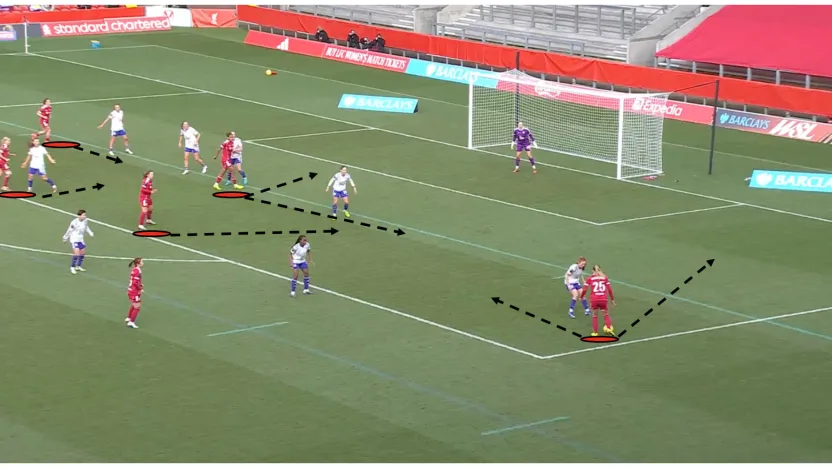
Here, we can see a good example of Liverpool committing bodies forward. Bergström is in possession, and she has four teammates in the box to aim for. Plus, their positioning in the box is intelligent; the Swede is 1v1 with her opponent, giving herself the opportunity to either go down the line or cut back onto her left foot.
Meanwhile, the Liverpool players in the box are occupying the Aston Villa back line, allowing themselves the space to make subtle but effective off-the-ball movements into space should a cross arrive.
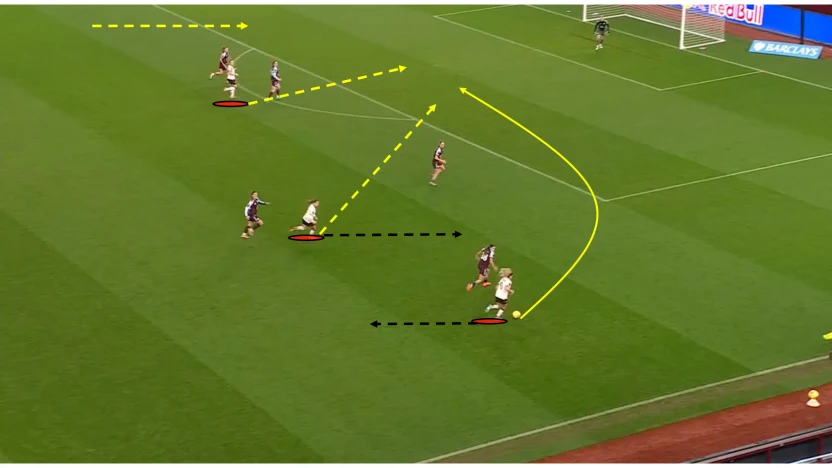
By contrast, if we look at what happened in a similar scenario during the reverse fixture, we can understand how significant this change is. In this image, the optimal outcome is indicated via the yellow arrows. Liverpool have broken down the right flank, with Kiernan on the ball.
To take advantage of the back-tracking defensive line, the Irish international would most likely look to whip in an early cross. For that to happen, Olsson needs to make a run into the box, which the central striker is doing here. Then Kapocs should change the angle of her run and head for the penalty area, ideally with a runner from midfield or the left flank crashing into the box from the far side.
However, what actually plays out is shown by the black arrows. Kapocs runs into the right half-space, dragging her opponent with her and forcing Kiernan to cut back inside, allowing Villa to fall back into their defensive shape.
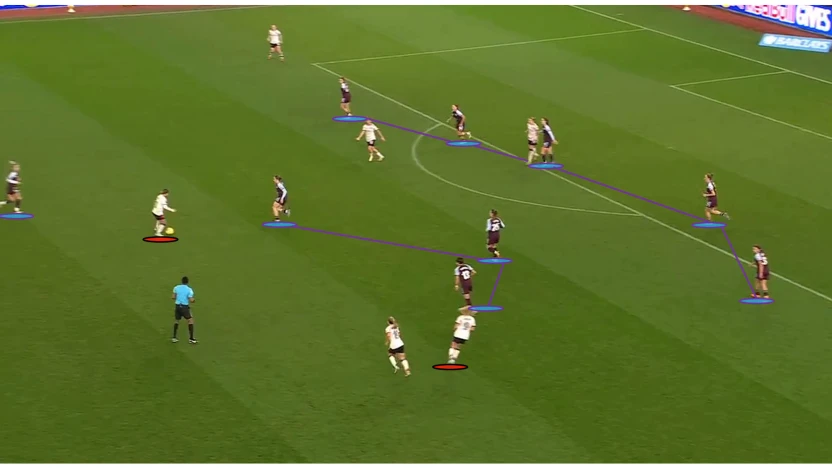
We can see here that Kiernan passes inside to Nagano, but Aston Villa have formed a back five, with three compact midfielders ahead of them, denying Liverpool access to vertical central passing lanes.
This forces Liverpool to recycle possession and allows Villa to deploy their pressing traps to regain the ball.
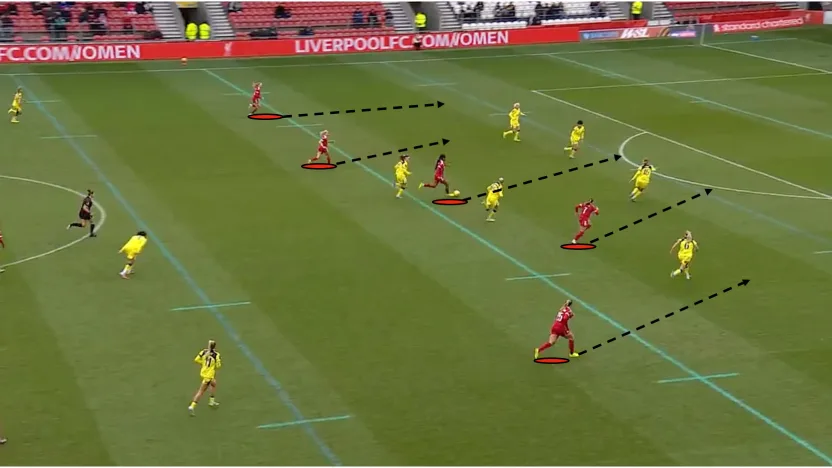
Moreover, the Reds are more willing to drive at their opponents through the centre of the pitch. Aurélie Csillag has provided an excellent outlet in this regard. Since her arrival at the club, she has averaged 3.19 progressive runs and 3.98 dribbles per 90. Once again, these numbers must be considered in the context of limited game time, but they do suggest Taylor is giving his players more freedom to drive at their opponents.
In this example, the Swiss forward recovers possession in the attacking third and immediately runs at the defensive line. Crucially, four teammates are making forward runs in support, creating multiple passing options should Csillag draw defenders toward her. This kind of coordinated movement was largely absent during the first half of the season, where Liverpool's attacks often became isolated, one-dimensional efforts.
Players are now making runs they previously hesitated to commit to, flooding the box and attacking with the collective purpose that was missing previously.
Intelligent Pressing
Gareth Taylor typically likes his team to press high; it’s a common feature of his tactical style. Throughout the first half of the season, his team struggled to execute it efficiently, and opponents often played through the press as a result.
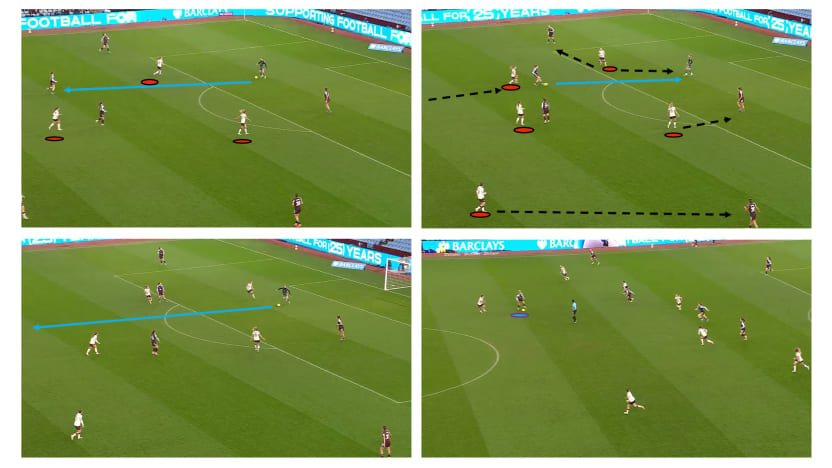
In this sequence, we can see Liverpool ready to press, limiting their opponent’s ability to play out from the back and forcing errors high up the pitch. On this occasion, Villa are able to play straight through the press with some intelligent positioning and passing through the lines.
The goalkeeper plays it into her midfielder, who, under pressure and unable to receive the ball on the back foot, plays it straight back to Sabrina D’Angelo. Recognising the backpass as a pressing trigger, Liverpool spring into action with Olsson ready to put the goalkeeper under pressure and teammates also ready to close down their opponents.
However, the Aston Villa keeper bypasses the press completely and plays a long ball into Rachel Daly, which takes out six Liverpool players, bypassing their forward and midfield lines, who had pushed so high to engage in the press.
With Liverpool's defensive structure completely broken, Villa now have a numerical advantage in transition. The space behind Liverpool's aggressive press has been exploited, a pattern that beset their early-season form. When the press failed, they were left dangerously exposed.
The addition of experienced midfielder Denise O’Sullivan means that Liverpool now have a solid midfield base with the Irish international accompanying Fūka Nagano, allowing Gareth Taylor’s side to successfully utilise pressing traps more effectively.
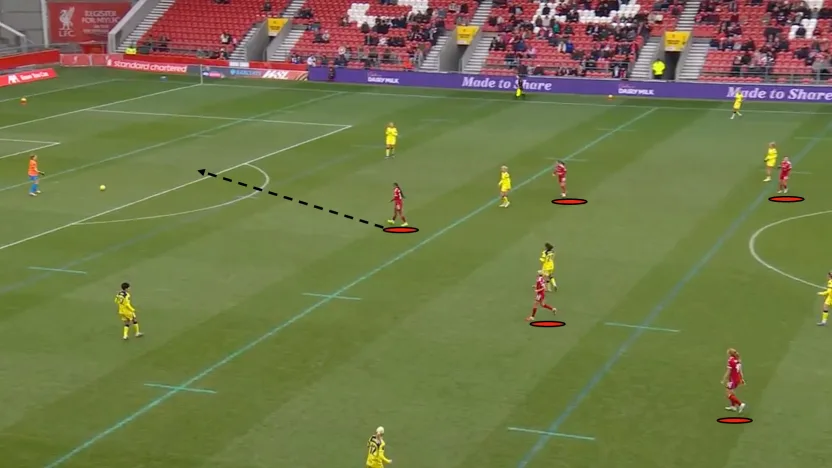
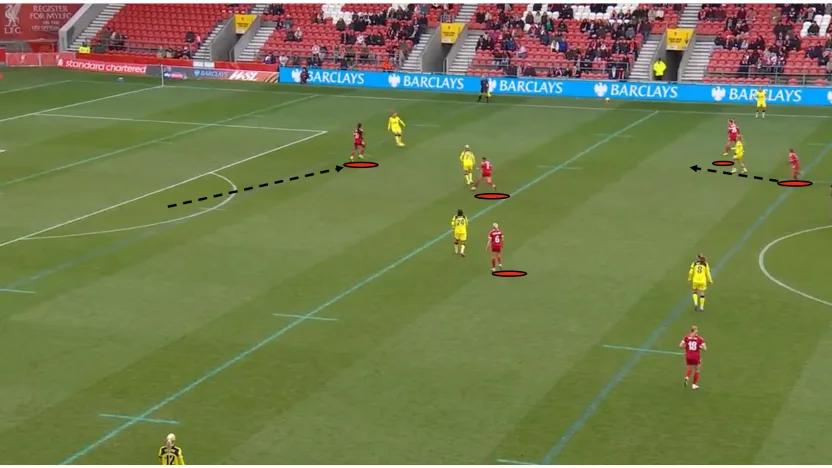
We can see here that, rather than using the backpass as a trigger, Liverpool position themselves effectively to force Tottenham to play the ball where they want it. Csillag initiates the press, and everyone else moves, only on her command.
Reading the goalkeeper’s stance and knowing she is right-footed, Csillag identifies that the pass will most likely be played to the left-sided central defender, so she presses.
Having forced Tottenham over to their left side, Liverpool can now move. We can see from the image above that every player is well-drilled, sticking close to their opponent. O’Sullivan is picking up Spence, Kapocs has got Summanen, whilst Bergström is covering Nildén. This forces the defender to play the ball forward to Holdt, where Nagano is waiting to step in and intercept.
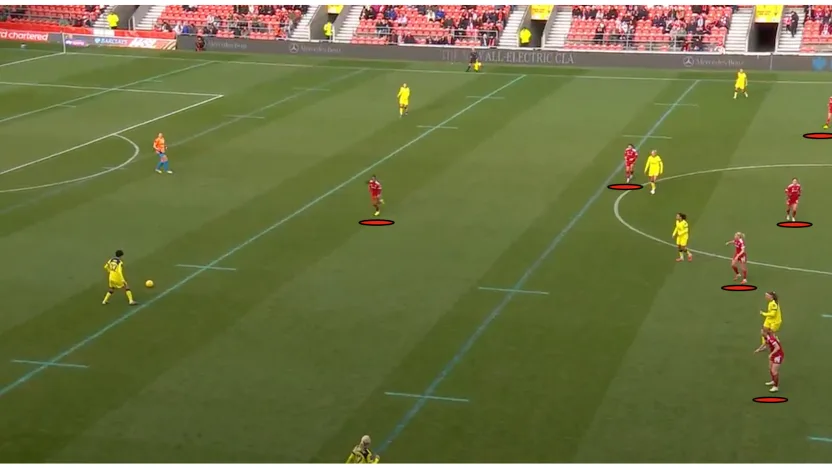
This image shows Liverpool with five in midfield when out of possession. The 4-5-1 shape allows them to close off the midfield passing lanes and often forces opposing defenders to go long, as on this occasion.
Importantly, Liverpool are no longer gambling on simply winning the ball high; they're forcing opponents into predictable decisions and then executing the trap with precision. The presence of O'Sullivan alongside Nagano provides the midfield intelligence to read these situations, and dynamic forwards like Csillag and Bergström ensures opponents have nowhere to hide.
The defensive improvement stems not from radical tactical change but from smarter execution. Liverpool press more aggressively (their PPDA is down to 11.94 from 12.69) but require fewer desperate interventions. Over the last four games, the number of interceptions has dropped 21%, and sliding tackles down 44%. This suggests a team defending on the front foot, forcing opponents into mistakes rather than chasing shadows.
Conclusion
Liverpool's escape from the relegation zone shows the squad rediscovering its collective purpose. Gareth Taylor hasn't abandoned his possession-based principles; instead, he's adapted them to suit the current squad.
A few good performances cannot erase twelve winless matches, and Liverpool remain far from safe. The sample size is small, and the BWSL fixture list is unforgiving. However, the collective improvement and tactical discipline have put the Reds back in the driving seat in terms of retaining their BWSL status.
Whether this turnaround proves sustainable will determine Liverpool's future in the league. For now, though, they've shown enough to make survival possible.