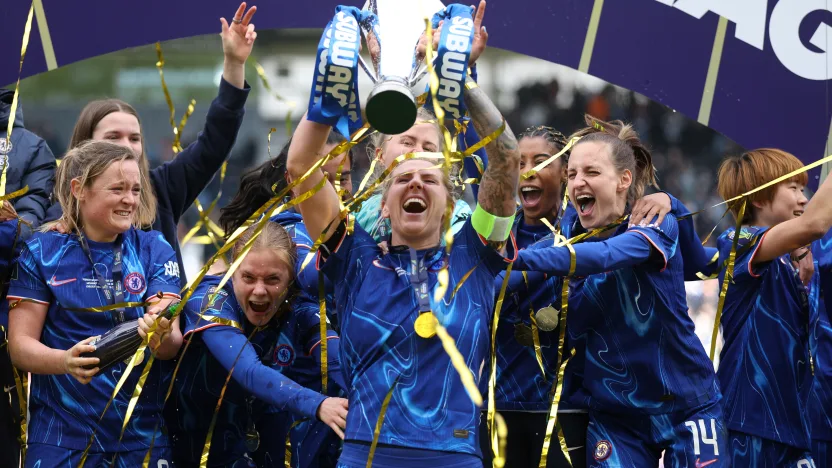
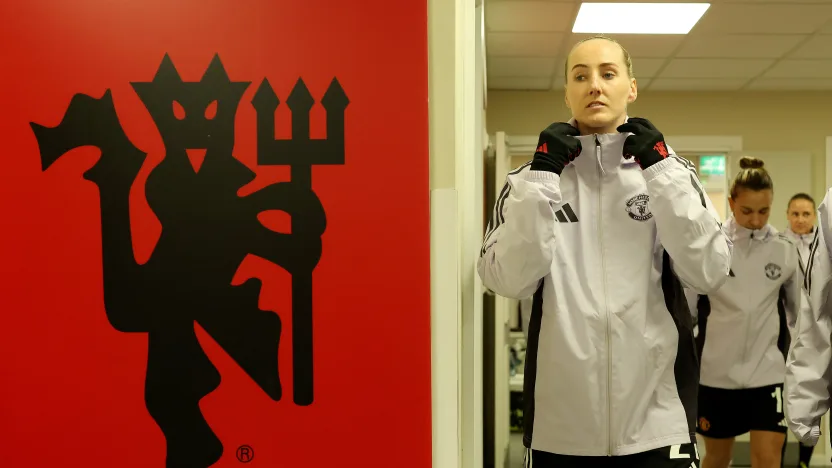
Ashton Gate will host the first major domestic silverware of the English women’s season on Sunday as Chelsea and Manchester United meet in the 2026 Women’s Subway League Cup final.
For Manchester United, the final represents a chance to secure the League Cup for the first time in the club’s history and add their name to the competition’s exclusive list of winners. Marc Skinner’s side have steadily grown into consistent challengers in recent seasons, and lifting another piece of silverware would mark an important step in the club’s development at the top end of the English game.
Chelsea, meanwhile, approach the final from a different perspective. While the Blues remain one of the dominant forces in English women’s football, their campaign has not unfolded entirely according to plan. With Manchester City currently setting the pace in the league title race, the Subway League Cup offers Sonia Bompastor and her players an opportunity to reassert themselves and ensure the season delivers tangible success.
The two sides are already familiar with one another this season. Their first meeting came in October at Leigh Sports Village, where Manchester United frustrated Chelsea in a 1–1 draw, limiting clear chances and forcing the visitors to settle for a point. More recently, the two met in the FA Cup in a tightly contested encounter that the defending champions edged 2–1, with their effectiveness from set pieces proving decisive.
United have already shown they are capable of disrupting Chelsea’s rhythm, while Chelsea have demonstrated they possess the quality to find decisive moments even in closely fought games. With both sides now competing for silverware, the tactical details that shaped those earlier encounters could once again play a significant role at Ashton Gate.
In this tactical preview, we will look ahead to the game and explain how we expect both sides to set up and where both can gain an edge as they look to claim the title.
Manchester United Tactics
Overview
Marc Skinner has been one of the most tactically consistent managers in English women’s football this season. The Manchester United manager typically sets his side up in a 4-2-3-1 system, with the midfield double pivot forming the team's structural foundation.
That pairing is usually characterised by a clear division of roles. There is one deeper anchor tasked with maintaining positional discipline in front of the defence, alongside a more mobile box-to-box midfielder who links play and supports attacks.
The most immediate tactical concern for Skinner will be the absence of Hinata Miyazawa, who is away on international duty. As a result, he may be forced to adjust the balance of Manchester United’s midfield. Miyazawa has typically operated as the team’s deepest midfielder this season, providing positional discipline in front of the defence and acting as the anchor within United’s double pivot.
In her absence, Julia Zigiotti Olme is the most likely candidate to drop into that deeper role. Olme has generally been used as the more mobile, box-to-box presence in United’s midfield, but her experience and defensive awareness make her the most natural option to take on the responsibilities of the holding midfielder.
If Olme is tasked with anchoring the midfield, the dynamic of the double pivot could shift slightly. Ella Toone would usually be required to operate deeper than usual as the second midfielder, taking on more of the box-to-box responsibilities in order to connect United’s build-up with the attacking line ahead. However, the England international is set to miss the final as she recovers from a hip injury, meaning Lisa Naalsund will potentially be deployed instead.
That would then open space for a different profile in the 8/10 hybrid role. Lea Schüller or Jess Park could both occupy the role behind the striker, depending on the balance Skinner wants in the attacking line.
In possession
During build-up, Marc Skinner typically asks his full-backs to advance high up the pitch, with Jayde Riviere particularly aggressive on the right. To maintain defensive balance, the midfielder on that side (often Julia Zigiotti Olme or Hinata Miyazawa) will drop into the vacated space to provide cover if possession is lost.
This rotation allows United to commit numbers forward without exposing the back line. From there, centre-backs Maya Le Tissier and Dominique Janssen play an important role in initiating attacks, using their passing range to spread play and find the advanced full-backs in wide areas.

We can see here that Julia Zigiotti Olme has dropped into the defensive line, allowing Jayde Riviere to advance higher on the right flank. This rotation helps maintain defensive security while still enabling United to stretch the opposition’s structure during build-up. It is particularly useful against a high press, as the additional player in the first line allows United to circulate the ball more comfortably before progressing play into wider areas.
The data supports this pattern as both fullbacks rank among the most frequent pass recipients in the side, with Anna Sandberg (38.76) and Jayde Riviere (31.03) ranking in the top six Manchester United players for received passes per 90 among those with at least 600 minutes played this season. Their high involvement reflects how United often utilise them both as key outlets during build-up, receiving possession after the central defenders draw pressure before carrying or passing the ball into advanced areas.
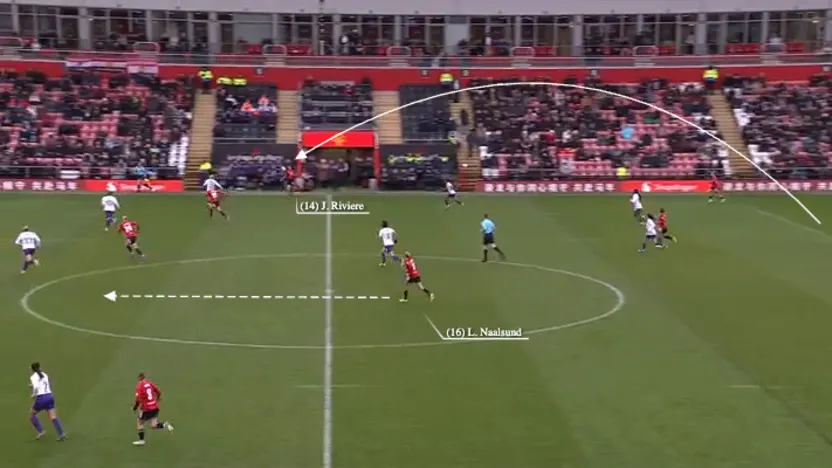
This structure can also create space in central areas for attacking players to exploit. As they circulate possession toward the fullbacks, United often draw the opposition’s defensive press wider, forcing their midfielders to shift across the pitch to apply pressure.
This movement can open passing lanes inside, allowing players such as Toone or, in this case, Lisa Naalsund, to make forward runs through the centre. Consequently, the wide build-up helps United advance the ball up the pitch, creates opportunities to attack the spaces between the lines, and forces the defensive line backwards through the number of attacking players.
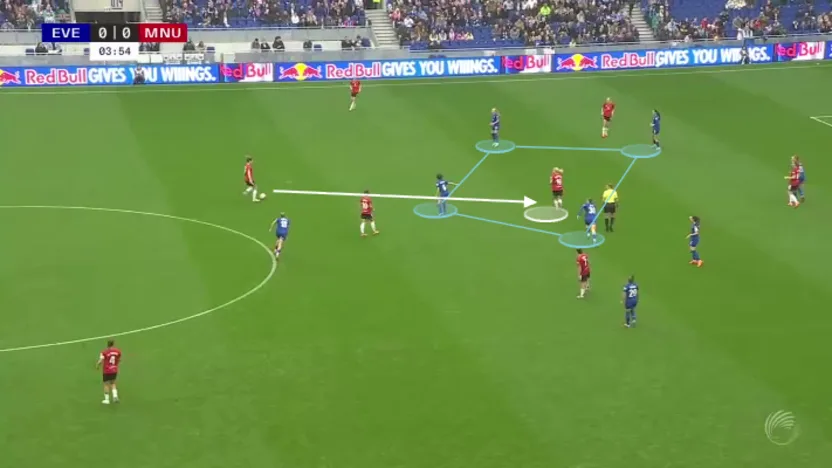
Naalsund has a real vision for drifting into pockets of space to receive the ball, as we can see here. When facing a team that defends in a deeper block, where central space is often limited, this becomes invaluable and may prove extremely important in moments when Chelsea are sitting in their shape.
Her ability to find gaps between the opposition’s midfield and defensive lines means she provides an important passing option in the build-up, helping United advance the ball into more dangerous areas. This also draws defenders out of position, creating room for teammates such as the advancing fullbacks to exploit in the final third.
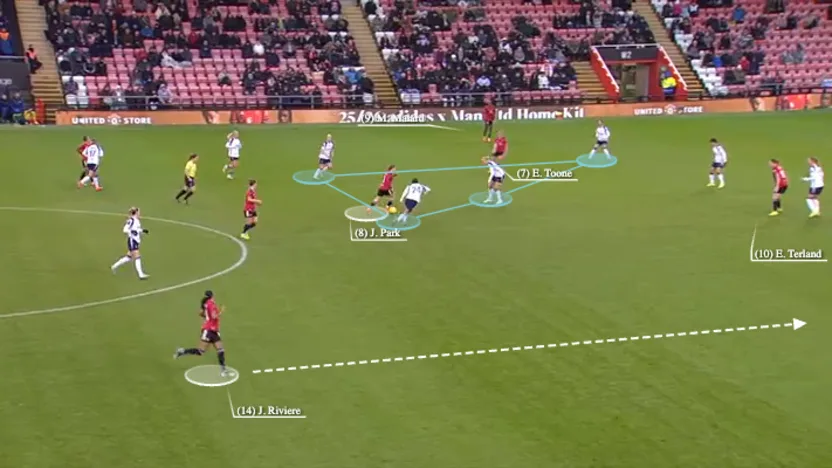
Jess Park has been a revelation since joining Manchester United from Manchester City. Primarily deployed on either flank, Skinner’s tactics provide the freedom to drift inside, making her far more difficult for opposition defenders to track. This means Park can receive the ball between the lines and carry possession into tighter spaces, where she can combine with the advanced midfielder.
Furthermore, the data reflects her ability to progress attacks through ball carrying. Park averages 3.67 dribbles per 90 with a 64.9% success rate, alongside 2.9 progressive runs per 90, highlighting how frequently she drives forward with the ball. Once possession reaches the final third, she also provides a goal threat, recording 2.77 touches in the box per 90, 2.12 shots per 90, and 0.39 goals per 90.
Her movement inside can also help manipulate the opposition’s defensive structure. By drifting centrally and receiving in crowded areas, she often draws defenders across the pitch. Creating space on the outside for the advancing fullbacks to exploit allows United to maintain width while still attacking through central areas.
Out of possession
When possession is lost, United tend to prioritise counter-pressing as soon as possible. The nearest players attempt to delay the opposition’s first pass forward, giving the midfield and defensive lines time to recover their shape.
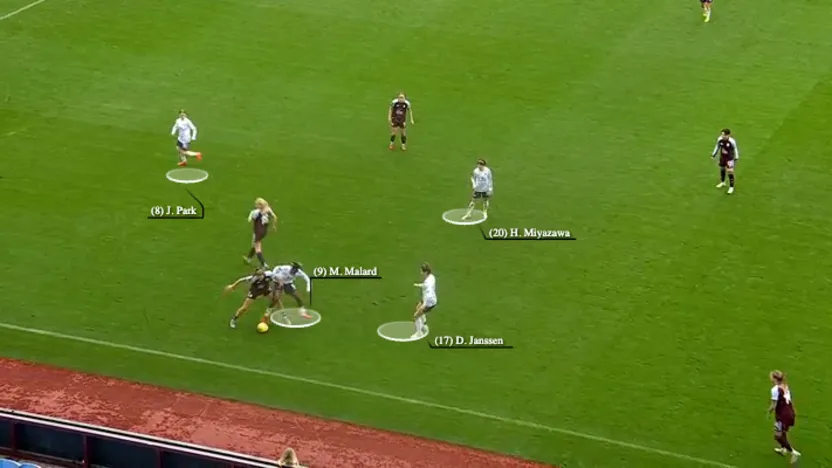
Here we can see how United hunt in packs when pressing the ball. With Dominique Janssen stepping forward and players such as Melvine Mallard, Hinata Miyazawa and Jess Park all in close proximity, United are able to apply immediate pressure on the ball carrier.
Their coordinated pressing often forces the opposition into rushed decisions, leading to high turnovers or misplaced passes that United can quickly recover.
United’s pressing approach is also reflected in the data. Skinner’s side average a PPDA of 10.1, indicating a willingness to apply pressure on the opposition during build-up phases rather than sitting in a passive block.
However, when United welcomed Chelsea to Leigh Sports Village earlier in the season, their PPDA rose to 14, and in the recent FA Cup meeting, it climbed even higher to 16.65. These numbers suggest that when facing Sonia Bompastor’s side, Marc Skinner has preferred a more conservative defensive approach, allowing Chelsea greater possession, setting his team up in a mid-to-low block, and looking to attack on the counter.
What will be particularly interesting ahead of this final is whether Skinner sticks with that strategy or alters his approach. With a trophy on the line, he may opt for a more aggressive pressing structure in an attempt to disrupt Chelsea’s build-up earlier in possession.
Chelsea Tactics
Overview
The 2025/26 campaign has been a challenging one for Chelsea, with the Blues struggling to establish the same consistency that has defined much of their recent domestic success. That uncertainty has also been reflected in Sonia Bompastor’s tactical approach, with the French manager experimenting with several different structures throughout the season.
Chelsea have most commonly operated in either a 3-5-2 or a 4-3-3, although Bompastor has also utilised a 4-2-3-1 and a 3-4-1-2 at various points during the season. Her tactical flexibility highlights a willingness to adapt to different opponents, but it has also meant that Chelsea have at times lacked a single, clearly defined tactical identity.
Despite these structural changes, certain principles have remained consistent. Bompastor’s Chelsea typically aim to dominate possession, build their attacks through the midfield, and apply aggressive pressure when they lose possession. The variation in formations has therefore been less about changing the overall philosophy and more about adjusting the players' positioning within that framework.
Heading into the Subway League Cup final, it will be interesting to see which system Bompastor opts for. Against Manchester United’s organised defensive structure, Chelsea may favour a setup that allows them to control central areas and maintain sustained attacking pressure.
Moreover, one reason for Bompastor’s use of the 3-5-2 system has been to accommodate both Lucy Bronze and Ellie Carpenter in the same lineup. In this structure, Carpenter has typically been deployed as the right wing-back, given the licence to advance aggressively and utilise her attacking strengths along the flank. Bronze, meanwhile, has operated as the right-sided centre-back, where her experience and passing ability allow her to step forward and help progress the ball through central areas.
However, Carpenter will be absent for the final as she, along with teammate Sam Kerr, is away on international duty at the Asian Cup. As a result, Bompastor may be forced to adjust that dynamic, with Bronze potentially shifting into the right wing-back role to provide attacking width on that side.
One option would be to move Bronze into the right wing-back role to maintain the back three system. Our best guess? The manager will likely revert to a back four, giving Chelsea greater balance across the back line and more bodies in the midfield third, where United could punish them.
In possession
In possession, Chelsea look to utilise positional rotations to drag their opponents out of position and create space.
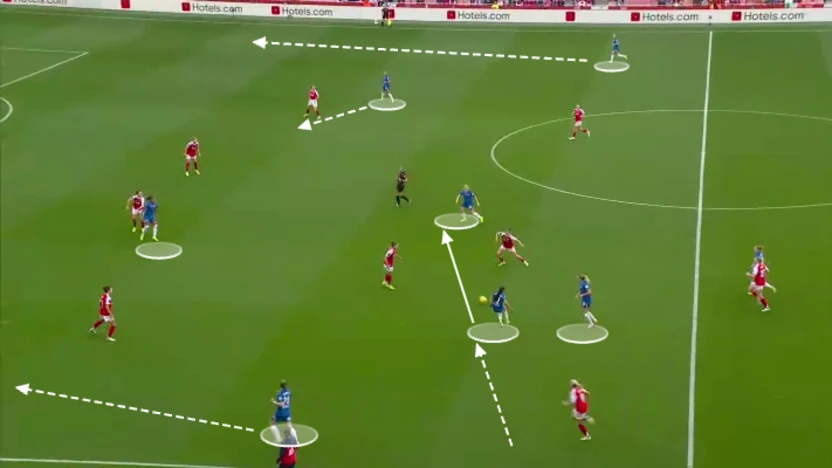
This is designed to create space on the outside for the fullbacks or wingbacks to advance into. In this example, Alyssa Thompson drifts inside, carrying the ball into central areas, drawing defenders toward the middle of the pitch and opening space for Niamh Charles to advance down the left flank.
A similar pattern can be seen on the opposite side, where Johanna Rytting Kaneryd moves infield from the right. This vacates the wide channel and allows the right back to step forward into space, providing Chelsea with width and an additional attacking outlet in the final third.
Alyssa Thompson is the key player in the attacking build-up. She provides Chelsea with an important outlet for ball progression in attack. Operating primarily on the left, she is frequently tasked with carrying the ball forward and advancing play. The data highlights this role clearly, with Thompson averaging 4.25 dribbles per 90 with a 63.5% success rate. Plus, she averages 3.27 progressive runs per 90, underlining how often she drives the ball into advanced areas.
Once Chelsea progress into the final third, the American international also offers a significant attacking presence, recording 5.23 touches in the box per 90 and 1.96 shots per 90. The combination of ball-carrying and attacking movement is what makes her such an important player for Chelsea, particularly when they look to progress play quickly or attack space behind the opposition's defensive line.
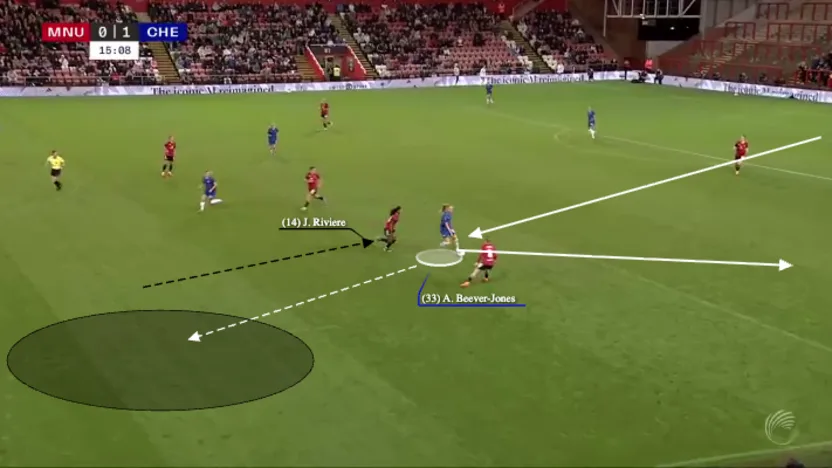
Bompastor saw her side use these positional rotations to good effect when Chelsea faced Manchester United in the league back in October. They particularly looked to draw Jayde Riviere out of position and exploit the space in behind.
In this example, Aggie Beever-Jones moves centrally to receive the ball from Hannah Hampton, whose distribution is a valuable part of Chelsea’s build-up. As Beever-Jones drops short, the Manchester United fullback follows closely, leaving space in the wide channel.
The Chelsea forward confidently lays the ball off to Sandy Baltimore before spinning beyond Riviere and making a run down the left flank. Baltimore then releases the pass into the vacated space, allowing the England international to run onto the ball. This shows how, in a single combination, Chelsea can progress up the pitch and attack the space behind United’s defensive line. This is something Marc Skinner’s side will need to be wary of in Sunday’s game.
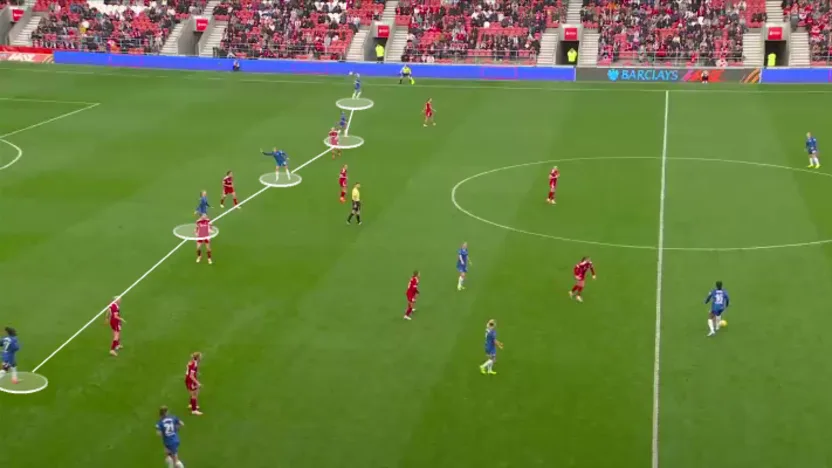
Whichever system Bompastor opts for, one constant in Chelsea’s approach is the emphasis on providing multiple attacking options. When enjoying sustained spells of possession, the Blues often commit to a front line of five, pushing players high across the pitch. As shown here, this structure pins the opposition's back line deeper and limits their ability to step forward and support the midfield.
From there, one or two of the Chelsea players will drop short to receive the ball, drawing their markers out of the defensive line. Their movement then creates space in behind, allowing the remaining Chelsea attackers to exploit the gaps that appear between defenders. It is these rotations that allow the West London side to manipulate opposition defensive structures and create attacking opportunities.
Out of possession
Chelsea are one of the more proactive pressing sides this season, with a PPDA of 8.9, indicating they look to apply pressure high up the pitch rather than retreating into a passive defensive block.
The front line will often initiate the press by closing down the opposition centre-backs and attempting to lock the ball on one side of the pitch. The midfield line then pushes up aggressively to compress space and prevent central progression.
This pressing structure is designed to force opponents into predictable passing lanes, particularly toward the touchline, where Chelsea can force errors and nullify the attack. When executed well, multiple players will converge on the ball carrier, allowing the Blues to quickly recover possession in advanced areas and transition into attack.
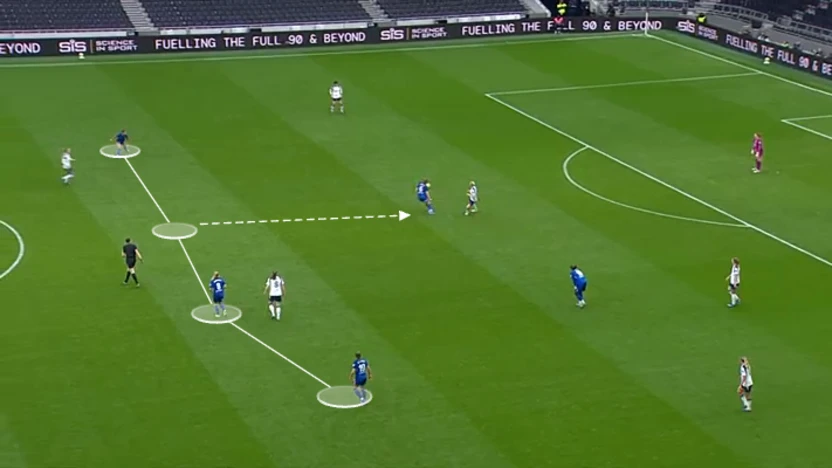
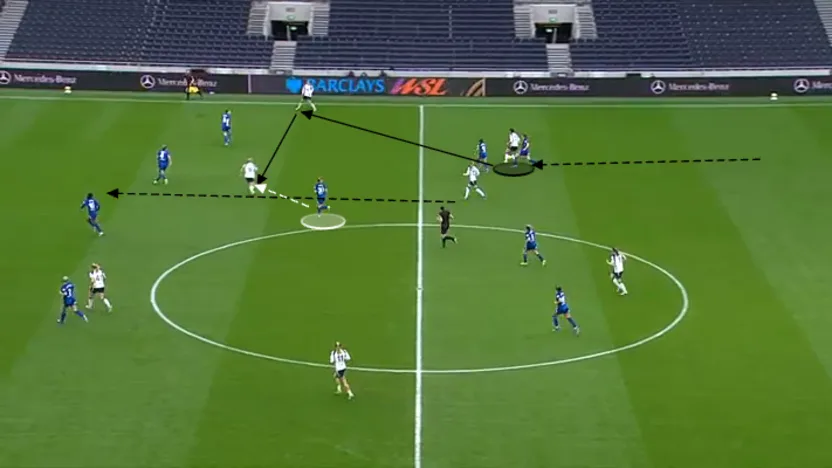
However, this aggressive approach can occasionally leave them vulnerable if the first line of pressure is bypassed. In this example, Nüsken steps forward to press the ball carrier, but Tottenham move the ball quickly into the wide area and play through the press.
Once the initial pressure is broken, they can briefly be stretched, with wider gaps appearing between the midfield and defensive lines. This can allow opponents to advance into the middle third before they can fully recover their defensive shape.
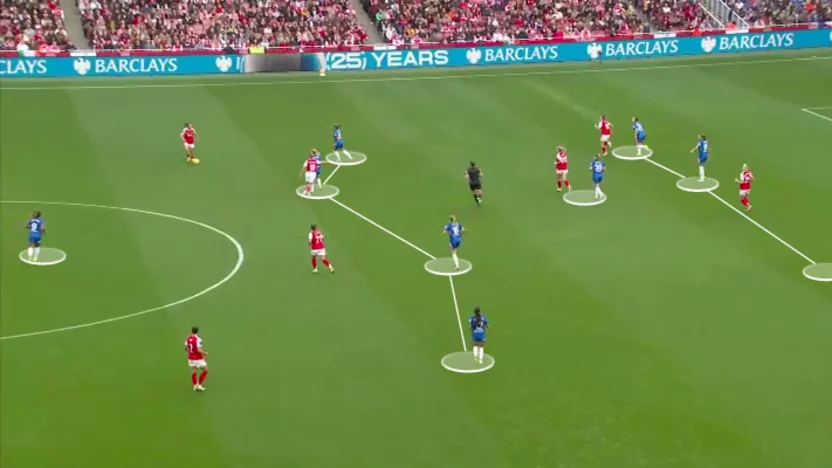
To be honest, Bompastor’s side look far more defensively secure when they settle into a compact 4-1-4-1 shape.
In this structure, the single pivot, usually Keira Walsh, screens the space in front of the centre-backs, while the midfield four remain narrow and disciplined, limiting opponents' opportunities to play through central areas.
The protection in the middle of the pitch and forcing play wide mean Chelsea can control the defensive phase more effectively before stepping out to apply pressure once the ball reaches the flanks.
This dynamic could prove particularly important against Marc Skinner’s Manchester United side. We know that United’s build-up frequently looks to progress play through their full-backs before attacking central spaces through runners from midfield.
So, if Chelsea’s press can disrupt that early progression, they could pin United back in their own half. However, if Skinner’s side are able to bypass the first line of pressure, the spaces left behind Chelsea’s advancing midfield could provide opportunities for them to attack.
Conclusion
Ultimately, Sunday’s final is likely to be shaped by the tactical approaches of the two sides. Both managers have shown a willingness to adapt throughout the season, meaning the battle on the touchline will be just as important as the one on the pitch. Everything points to Chelsea looking to dominate the ball, especially with both Miyazawa and Toone missing for the Red Devils.
It’s important to remember that United have already held Chelsea to a draw, though; they know how to make themselves hard to beat. If they can get Jess Park on the ball and she’s able to weave her magic, it's entirely possible the trophy will be heading back to Manchester.
The game is a difficult one to predict; both sides are capable of winning. History perhaps favours Chelsea, but United have the ability to defend resolutely and the players to produce a moment of individual quality. Both sides will feel they can win it. We'll find out on Sunday.