Everton and Japan defender Hikaru Kitagawa on learning British English, adapting to a more physical league and why Everton now feels like family.
“Thisismydreamplace.TheBarclaysWSListhebiggestleagueintheworldandmanyJapaneseplayersarehere.”Hikaru Kitagawa
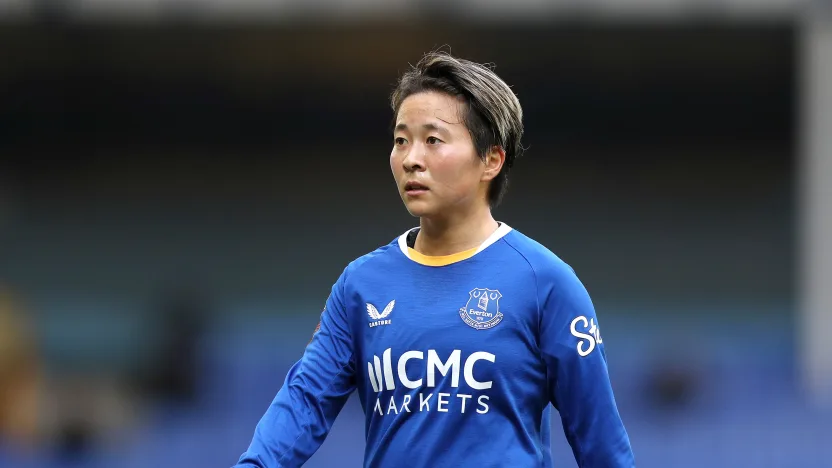
As Hikaru Kitagawa walks over for the purposes of our interview, there is a faint look of dread on her face. The Japanese defender has rarely spoken to media in English outside of Everton’s club channels, and so the prospect of a ten-minute conversation feels daunting. But Kitagawa sits down and, as she has done throughout the rest of her career, throws herself into this latest challenge.
Kitagawa joined Everton in June 2025 from Swedish side BK Hacken, where she became the first Japanese player in the club’s history. The defender had been one of Japan’s standout players at the 2024 Olympic Games and was part of the BK Hacken team that would go on to win the 2025 Damallsvenskan title just a few months after she departed for Merseyside.
The route from Sweden to the BWSL is a well-trodden path and Everton brought Kitagawa in for both her experience and leadership qualities. The defender spoke to Japanese compatriot Honoka Hayashi before joining, but ultimately the decision to join Everton was relatively simple.
“This is my dream place,” Kitagawa says. “The BWSL is the biggest league in the world and many Japanese players are here.”
It is true that the BWSL’s Japanese contingent is growing. Figures from fbref show there are 22 Japanese players in the league this season, more than the number representing Spain, France and Netherlands. Kitagawa says the league’s Japanese community helped her to settle in Merseyside, but her compatriots faced similar difficulties adapting to the league’s style.
“We are learning British-style football,” she says, “because Japanese players have technical skills and intelligence but in England we have to get strong. I am getting used to playing with physicality, more tackles and smashing.”
Arguably the biggest barrier for Japanese players like Kitagawa is the language. She is apologetic throughout the interview, confessing her English is not at the level she wants it to be, and there is a sense the language barrier is keeping the full-back in her shell. Away from training, Kitagawa is learning English via YouTube but even that became problematic when she arrived in Merseyside.
“When I came here I felt it was difficult because I was learning American English, but here they speak British English,” she says. “The pronunciation is really difficult. I couldn’t hear all the English and then Scott [Phelan], he is Scouse, [which made things] more difficult. But I'm comfortable now.”
Kitagawa’s Everton teammates have helped her to overcome initial difficulties, and she praises them for their kindness. Some teammates have even taken the opportunity to teach Kitagawa English phrases – particularly those of a Northern variety.
“They say ‘buzzing’ – I don't know if it is Manchester English – and ‘chock-a-block’,” she laughs. “I’m learning a lot of slang!”
Kitagawa has done a lot of her talking on the pitch. The full-back scored on her debut against Manchester City in the Subway Women’s League Cup, curling an effort from inside the box into the top corner. A few months later, versus Aston Villa, Kitagawa produced a near-identical finish, helping Everton to just their fifth point in their opening six BWSL games.
While Kitagawa is not averse to a spectacular strike, her disciplined defending is the bedrock of her performances. She has become one of Everton’s most consistent defenders, playing in 15 of Everton’s 22 BWSL games last campaign – including at Kingsmeadow against Chelsea when Everton ended the 34-match unbeaten run of Sonia Bompastor’s side.
Playing in the BWSL has brought the best out of Kitagawa’s game, finding a “family” at Everton. Being away from Japan has brought its own challenges and, even if Kitagawa does not consider to have changed as a person, she is learning off the pitch as well as on it.
“I was a shy, shy person,” she says, “but here at Everton, everyone is always dancing and singing. I felt embarrassed – but now I can do it!”
Kitagawa’s Everton venture is the latest step in an impressive and storied career. With the Toffees now looking to make Goodison Park their own and build on last season’s eighth-placed finish, you imagine Kitagawa will be firmly part of those plans.