Chelsea fans were left pondering last season if Manchester City’s first Barclays Women’s Super League title in a decade spelled the end of their dominance.
But the Blues are second and still unbeaten after eight games - just two points behind the defending champions - are looking just as likely to romp to a fifth trophy under Sonia Bompastor.
The league leaders have produced some remarkable scorelines, beating Manchester United 5-0, Tottenham 6-2, and putting another six past bottom side Charlton last weekend.
They’ve scored 28 goals at a rate of 3.1 per game, with which they are set to end the campaign on 81 goals and beat Arsenal’s record of 70 during the 2018/19 league season.
The Gunners would go on to clinch the title that year.
How have Chelsea scored so many goals and will it lead them to beat free-scoring City to a ninth top-flight triumph?
How Chelsea have dominated matches
Chelsea’s 29.81 expected goals (xG) is just 1.81 higher than their actual output this season, meaning the number and quality of chances they’ve created is almost exactly reflected by their actual output.
This is only possible if you are in control of proceedings throughout 90 minutes and with 64.7% average possession, 0.6 goals conceded per game, and five clean sheets, this is precisely what the Blues have achieved.
Something that Chelsea have done extraordinarily well is managing the space in both halves of the pitch while on the defensive and in possession.
Sonia Bompastor tells her players to press high, yet more specifically do so by boldly going player-to-player in terms of marking - regardless of their preferred formation.
Chelsea deployed a narrow 4-3-2-1 against Tottenham, and instead of largely sticking to that shape off the ball - which would grant Spurs more room - they did the opposite.

This frame might look confusing.
Ellie Carpenter and Kadeisha Buchanan both appear out of position, while Lucy Bronze and Alyssa Thomspon are out wide and Lexie Potter pairs Katie McCabe at centre-back.
However, it’s all part of Chelsea’s master plan trying to win possession back.
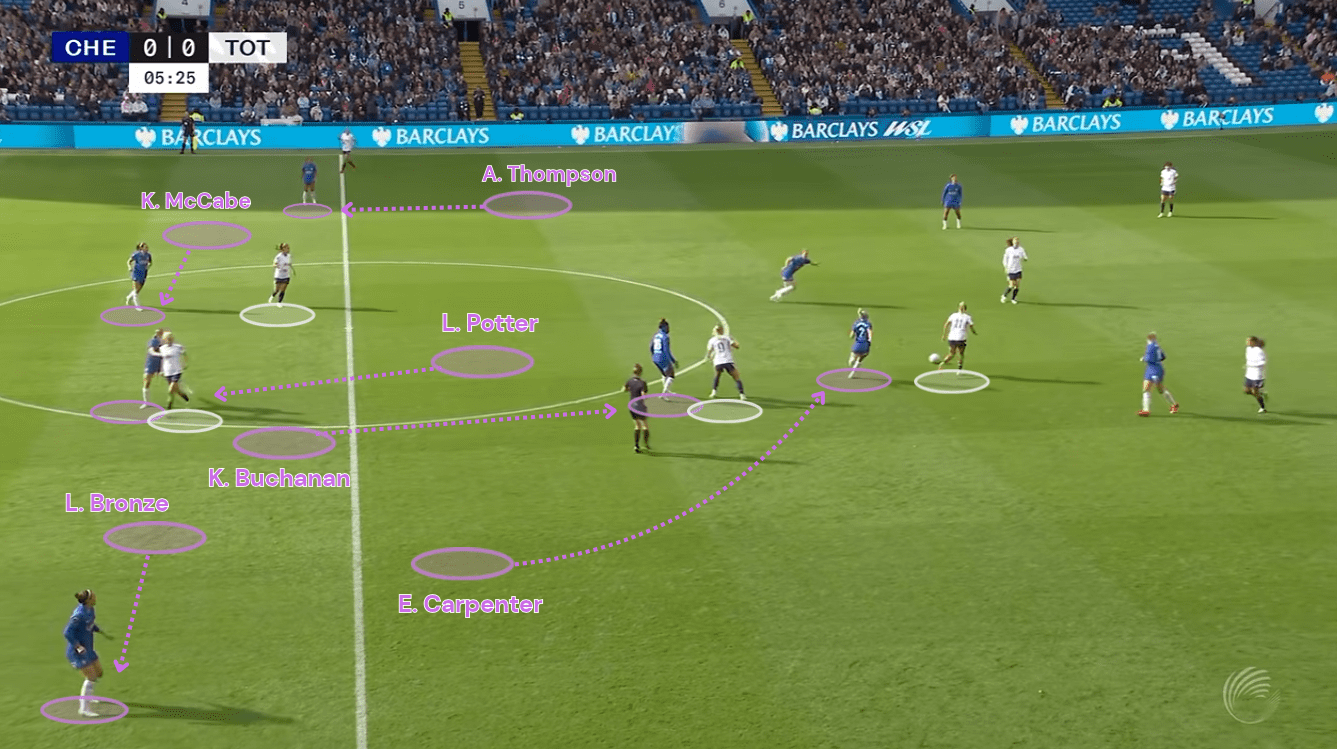
Buchanan stepped out from the centre of defence in order to contain the visitors’ number nine Cathinka Tandberg, as Carpenter pushed up to force left-winger Olivia Holdt back.
That decision has a domino effect: the deepest of the midfield trio, Potter drops into the space Buchanan left and in turn picks up Matilda Vinberg at the same time that McCabe moves inwards, hot on the heels of playmaker Victoria Pelova.
Carpenter’s intelligent press prompts Lucy Bronze to occupy her position, while left central midfielder Alyssa Thompson occupies McCabe’s usual space on the left.

Carpenter and Weike Capstein notice that Holdt and Signe Caupset switch spaces after the latter passes back to her goalkeeper, and in turn signal to each other they must also switch.
The central player marks their counterpart, and the wide player does too.
Goalkeeper Lize Kop is herself out of options and goes long, where Bronze is ready in the drop zone and gets Chelsea back on the ball - 10 seconds later, they’re in the Spurs box with Carpenter perfectly poised to make a dangerous run in behind the defence.
At first glance it’s a pretty trivial moment early on in the game, but on deeper inspection goes to show how well-oiled Chelsea are.

Chelsea have routinely gone player-to-player even if doing so sacrifices space in behind without other teammates accounting for it. They simply back themselves to win the ball.
This example from the last edition shows how effectively they pressed an out-of-sorts Manchester United, forcing a turnover and springing forward to score through Carpenter.
Chelsea’s opening goal against Spurs came from the same thing, as Lauren James punished Toko Koga’s loose first touch and danced her way in behind before converting.
The numbers reflect both the eagerness and effectiveness of Chelsea’s press: they rank first in the division for average starting distance per pressing sequence (51.2m), high turnovers (156), and the proportion of which ending in a shot (26) or a goal (3).
Bompastor has experimented with her formation and has often switched to a back three in either 3-4-3 or, more recently, a 3-4-2-1 shape, yet the principle remains the same.
Let’s go further and see who the key players are when Chelsea attack and how Bompastor’s tactical decisions have led to a remarkable 28 goals scored.
How have Chelsea scored so many goals?
There’s no better match to start with than the 6-0 victory over Charlton, where the Blues were 4-0 up inside the first 20 minutes.
In addition to their fluidity on the ball, Chelsea’s width and license to attack granted to each wing-back are key elements to the number of goals they’ve scored.
A rest defence of a back three proved to be a profitable decision that granted wing-backs Carpenter and Sandy Baltimore the license to move forwards into dangerous positions.

But take note of who’s in that resting trio here: McCabe (in possession) and Natalie Björn (middle), are joined by midfielder Keira Walsh (right).
It was Walsh that initially dropped deep to begin the passing sequence leftwards to Sjoeke Nusken, who shifted the ball onto McCabe.
Chelsea’s left centre-back Veerle Buurman noticed the chance to create an overload down the left wing, where Baltimore was poised ready next to James in the channel.
Walsh noticed too, and just held off her eventual run forward to ensure the Blues were protected against an unexpected turnover given that Carpenter had also advanced.

James turned brilliantly and fed Baltimore the ball for her to race away into the penalty area, where Melvine Malard and Manaka Matsukubo were ready to meet the cross.
And if Malard hadn’t turned the ball home, there’s Carpenter unmarked at the back post to try her own luck - Walsh had also made her way up to sweep up any clearance.
And that is not the first instance in this game, nor the season as a whole.

Minutes later, James is sent on a trademark run inside from the left wing again and Carpenter has made her way around the back of the Charlton defence.
Goalkeeper Anna Koivunen manages to parry the shot away but the Australian is on hand to fire in her fourth goal of the season, to lead the scoring charts among BWSL defenders.
The positioning of the 26-year-old’s teammates is also worth looking at. Once again, Malard and Matsukubo are in a great spot to try and attack the second ball while Walsh is a late arrival onto the edge of the box yet again and would be able to recycle possession.
As for Baltimore, she takes up a narrower position and makes an inverted run inside of Charlton’s wide midfielder and full-back since James was available by the touchline.
Chelsea have a vast array of options whenever they come forward and a solid rest defence to fall back on.

Same story against Spurs. This time, James managed to use her first-class dribbling and distribution to wriggle away from the visitors’ press and feed Thompson down the left.
She put her pace to great use by attacking the byline and cutting it back into the box. Carpenter gets herself up early, sees the room that Spurs have allowed her to get a shot away and takes the chance brilliantly.
Doing this requires a positionally aware, technically gifted, and highly athletic squad. The Blues evidently meet all of those criteria and then some.
Wing-backs fulfilling attacking duties as much as their defensive ones is nothing new in modern football, yet this shift is something that Chelsea have specifically worked on.
According to Carpenter’s movement patterns this season compared to last, she’s spending most of her time in the opponent’s half rather than her own.
Though this is inevitable when Chelsea dominate the share of the ball, the red areas of her heatmap (indicating the areas she spends most minutes in) are almost exclusively over halfway compared to last season - the Blues possession, however, saw a marginal increase from 59.9% last season to 64.7% in 2026/27.
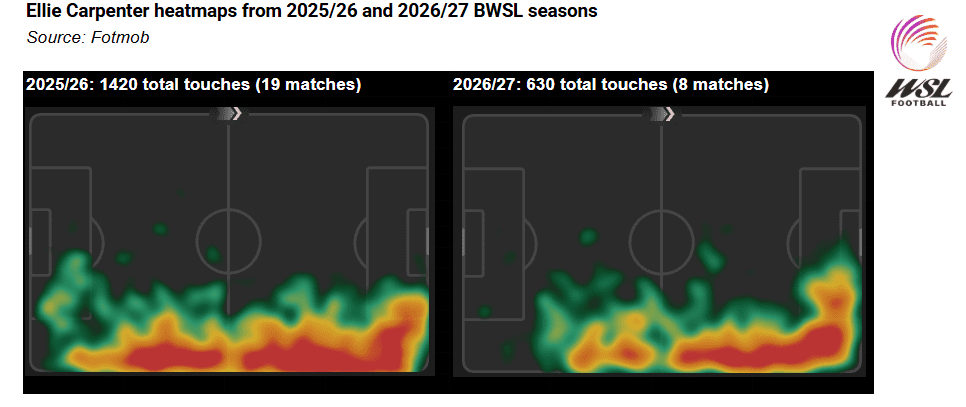
Carpenter has taken nearly half the number of her total touches last season in half the matches played, while doubling her tally of goals, and with 9 successful crosses from 43 attempts is currently one of the best at them in the BWSL.
The Australian international has been a revelation for Chelsea this season and her creativity out wide makes her one of several standout contributors to their high-scoring unbeaten run.
No Sam Kerr, no problem
Sam Kerr’s departure at the end of last season was one of the biggest stories to emerge from the competition for some time.
The Australian forward scored an incredible 85 league goals during her time at Stamford Bridge, hitting the 20 mark in consecutive seasons and was their main source of goals.
Melvine Malard had big boots to fill up front and has so far done a fine job, scoring six goals in as many appearances and accumulating 5.21 expected goals - second to Bunny Shaw.
But something worth noting is that Chelsea have already registered 13 different goalscorers, just one short of their total different scorers from the 2025/26 BWSL season.
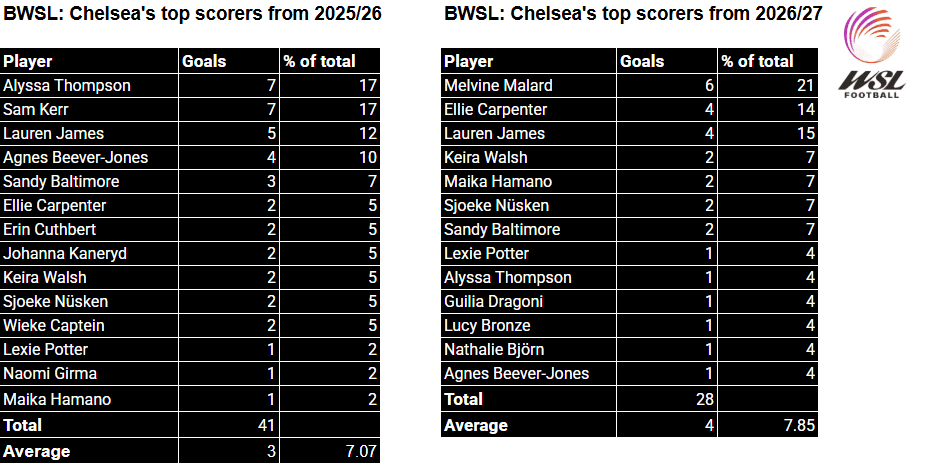
This means that alongside an increase of 0.7 average percent of their total goals, from 7.07 to 7.85 between campaigns, the share of goals is being spread wider across the squad.
Malard’s first season in blue has seen her account for 22% of Chelsea’s 27 goals, a rate of scoring that will easily take her past Kerr’s total from last season.
However, the French international has not suffered anywhere near the same issues as Kerr’s ACL injury that kept her out for much of the season.
Carpenter’s share has risen from 5% to 15% and Walsh from 5% to 7% of the goals, in the same time that James has seen a marginal 2% increase as well.
With such a fluid system as Chelsea’s, this will strike many as unsurprising.
Conclusion
To summarise then, Bompastor has ramped up the fluidity of her possession-focused passing style to the point that many members across their squad get into positions where they are able to convert chances into goals.
The emphasis placed on her wing-backs in the attacking phase, more so than last campaign, in addition to their deep tactical understanding with number 10 options Lauren James, Maika Hemano, and Manaka Matsukubo is a core element of their dangerous wide play.
Chelsea’s high press is another, meaning they win the ball back quickly and have coverage in the unlikely event they give the ball away in the attacking half.
Their attacking numbers in and around the box, coupled with James and Hemano’s ability to produce the spectacular from range, have them nailed on to be competing near the top.
While the Blues dropped two points in the 1-1 draw against Everton at the weekend, they know full well the quality they possess can help them to a massive win against Manchester City.
And if they do go on to win back the BWSL trophy, a long-standing record may fall in the process.