When Victoria Pelova left Arsenal and signed for Tottenham this summer, it’s fair to say that a few eyebrows were raised. The Netherlands international had spent three and a half years at the Emirates, winning two League Cups and becoming a popular figure within the squad and with fans alike. Her time at Arsenal was disrupted by an ACL injury and limited opportunities to establish herself, so with her contract coming to an end, Pelova opted to leave the two-time Champions League winners for pastures new.
Spurs represented a new challenge for Pelova, with Martin Ho looking to continue rebuilding the side and developing his possession-based brand of football. For Tottenham, the appeal was clear. Pelova is a technically gifted, versatile midfielder who adds another dimension to their creativity.
The opening weeks have shown that her new team are getting the best out of Pelova. The 27-year-old has netted five goals in as many appearances while establishing herself as the team’s key creative force in her attacking midfield role.
In this piece, we will take a closer look at Pelova’s role within Spurs’ tactical system, exploring how Martin Ho has chosen to utilise her skill set and why his approach is allowing the Dutch international to produce some of the best football of her career.
Data Analysis

The first thing that stands out when looking at the numbers is where Pelova’s attacking value comes from. She profiles as a box-crashing midfielder who arrives in the right place at the right time to contribute to the attack.
Her 4.03 progressive passes suggest she’s not looking to control games through her distribution. Additionally, her passing volume only ranks in the 52nd percentile. This suggests she isn't being asked to constantly dictate the tempo from deep. Instead, Spurs can use other players to progress possession before allowing Pelova to move into more dangerous positions.
Her 10.64 touches in the opposition box per 90 suggest Pelova is extremely active in the penalty area, perhaps the clearest indication of her role within this team. The data suggests she is regularly involved in the final stages of Tottenham’s attacking moves, whether that comes through a late run, a combination with a teammate, or a carry into the box.
However, the biggest standout here is her goalscoring. The former Arsenal midfielder is averaging 1.44 goals from 0.74 xG per 90, placing her in the 99th percentile among her positional peers for both metrics. Her shooting numbers reinforce the idea that Pelova’s recent goal-scoring run isn't simply down to finishing above expectation.
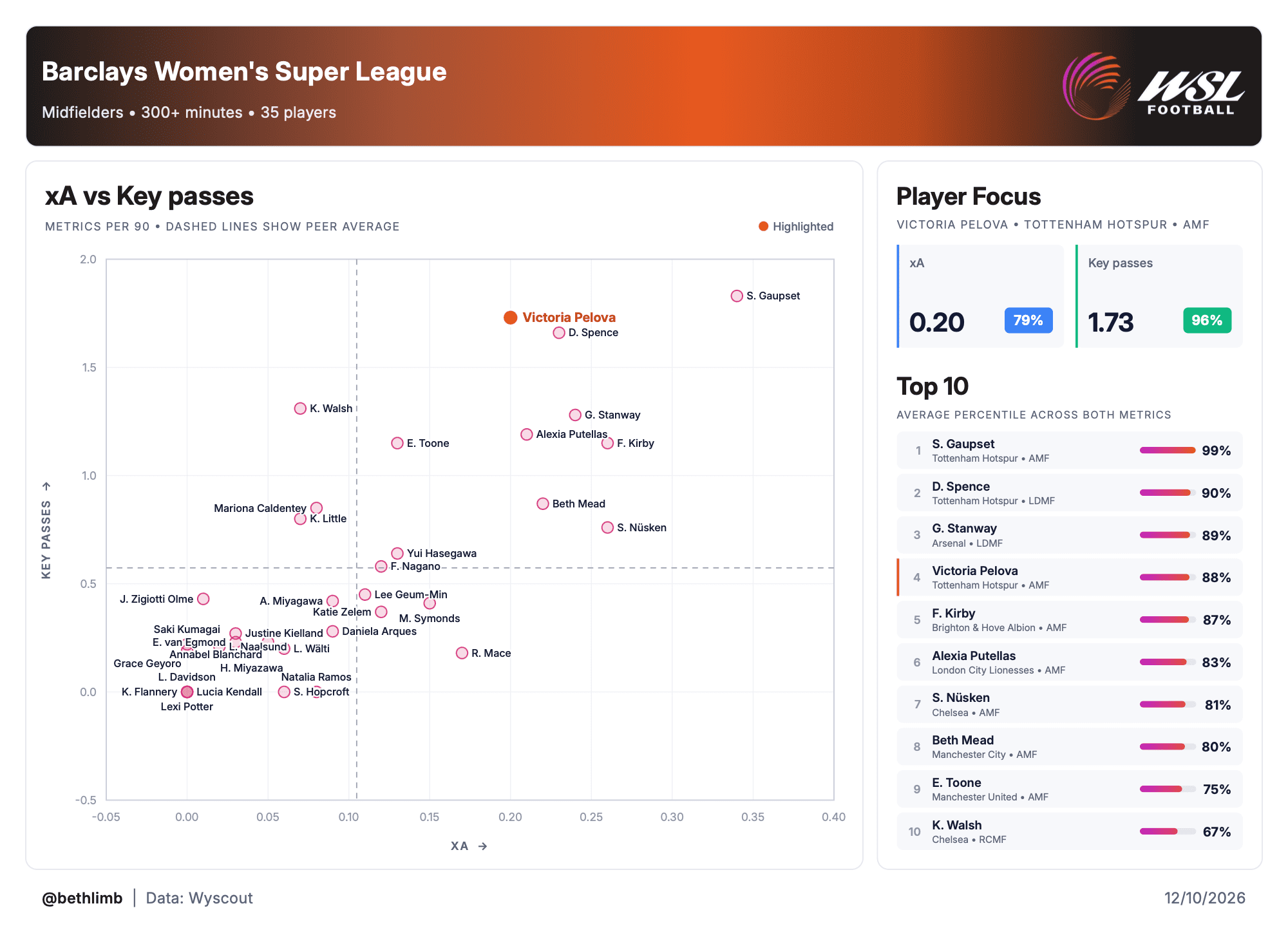
The 27-year-old’s attacking influence isn’t just limited to chipping in with the goals. She is also averaging 1.73 key passes per 90, showing she can create plenty of shooting opportunities for teammates.
This more attacking role has perhaps given Pelova a level of creative freedom she didn’t necessarily have at Arsenal. She is performing well above the positional average for both key passes and expected assists.
Interestingly, two of her Tottenham teammates, Signe Gaupset and Drew Spence, are also performing above the BWSL average in these metrics. This is important context for Pelova’s numbers, as it means Spurs aren't relying solely on her for creativity.
Overall, Pelova’s profile is that of a direct attacking threat. She can carry the team forward herself or make runs into space in the box to receive the ball in dangerous areas. Her dynamic style adds another facet to an already impressive Tottenham attack.
Ghosting In
So far this season, Pelova has typically been deployed as an attacking midfielder in a 4-2-3-1 system. Under Martin Ho, Spurs have evolved into a possession-based side, averaging 60.53% across their opening fixtures.
During build-up play, Tottenham often commit plenty of numbers ahead of the ball, with the likes of Olivia Holdt, Signe Gaupset, Kirsty Hanson and Cathinka Tandberg occupying advanced positions. The movement of the attacking unit can create pockets of space on the edge of the penalty area, which Pelova is particularly adept at identifying.
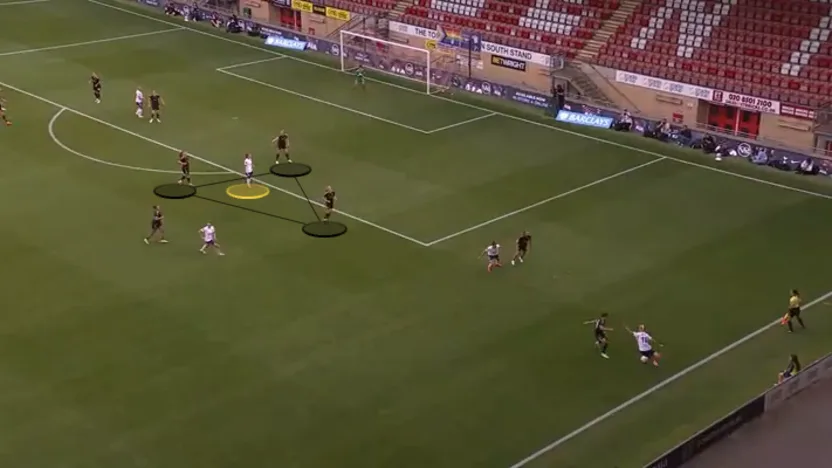
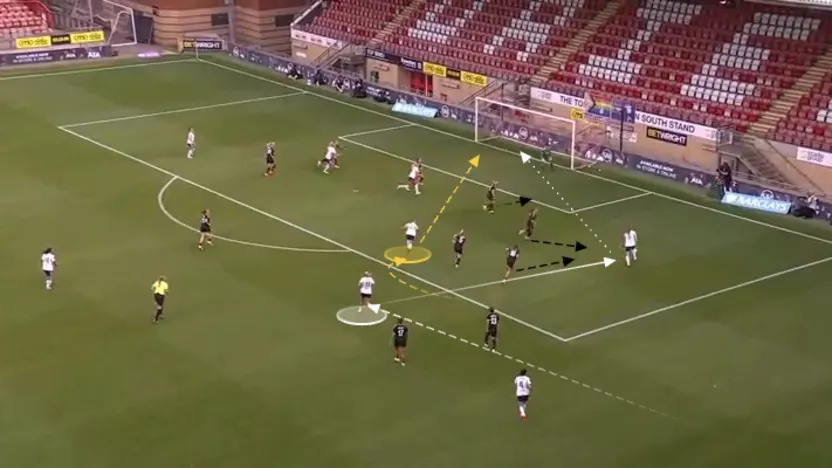
In this example, Pelova positions herself on the edge of the Aston Villa area, initially surrounded by three defenders. From here, the Tottenham midfielder doesn’t immediately attack the box; instead, she holds her position as the ball is worked infield from the right flank, allowing Villa’s defenders to become increasingly focused on the ball.
As the move develops, Gaupset makes a run into the box and creates enough space to receive the ball. The defenders are drawn across to block the forthcoming cross or shot, opening an area behind them for Pelova to attack. She ghosts into the box, unnoticed, arriving at exactly the right time. When Gaupset’s shot is saved by the goalkeeper, the Dutch international is on hand to tap in the rebound.
This is a relatively simple finish, but Pelova’s intelligent movement makes it possible. She waits for the right moment and only then does she attack the space.
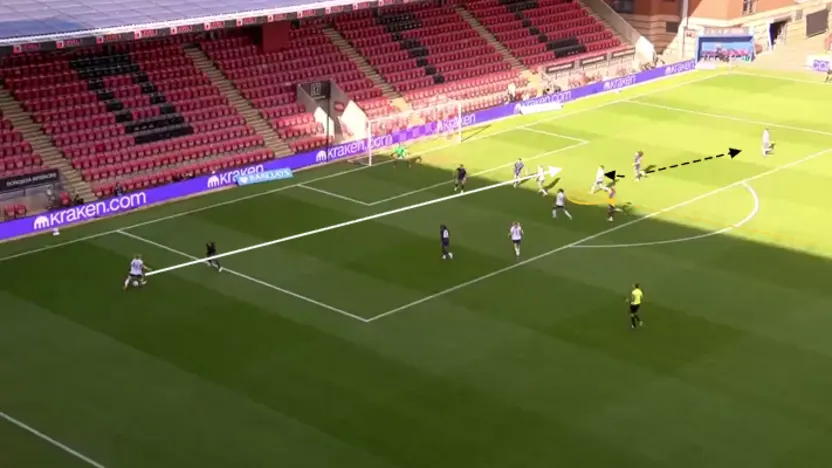
In this example against London City, Pelova again demonstrates her ability to time her runs perfectly. As Tottenham build the attack, she identifies the space inside the box and begins her run at the right moment.
We can see that the defender is caught between two threats; she is not sure whether to mark Pelova in the box or pick up the Tottenham runner arriving from the wide area. This brief hesitation is enough for Pelova to attack the cross. As a result, she gets her header on target and tests the goalkeeper.
This is a recurring theme in Pelova’s game. She doesn’t always need to beat a defender herself to find space; sometimes the movement of those around her creates the opportunity. Her ability to recognise that moment, hold her run, and then attack the space at the right time is a major part of what makes her such an effective box-crasher.
Linking Up
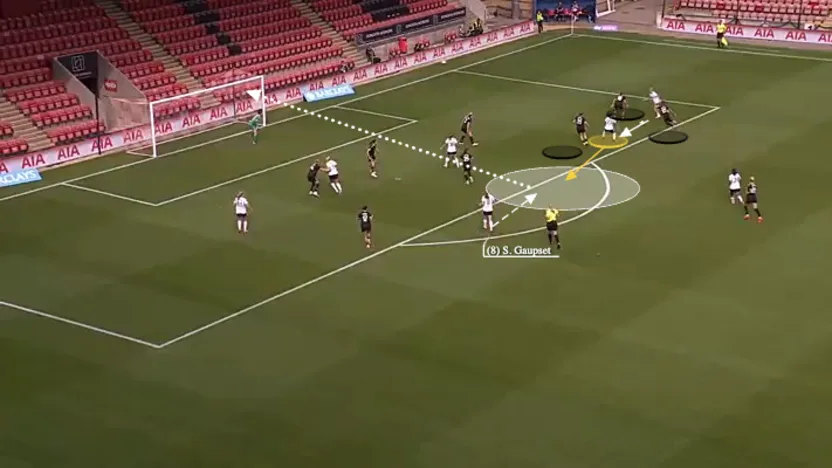
This example highlights Pelova’s ability to operate under pressure. Positioned on the edge of the penalty area, she receives the ball with three Villa players closing in. Most importantly, she doesn’t rush the next action; the Tottenham midfielder uses her composure and close control to turn away from the pressure before laying the ball off to Gaupset, who takes the shot on.
The key here isn't necessarily the final pass; it’s Pelova’s ability to retain possession and find the right option despite heavy pressure. With little room to work in, she understands that the best way to progress the attack is to draw the pressure, protect the ball, and then release it at the right moment.
This is where her creative profile becomes very interesting. The former Ajax player doesn’t always need to play the decisive final pass to influence an attack. Her ability to receive in congested areas, manipulate pressure, and combine quickly gives Tottenham another way to progress attacks around the penalty area.
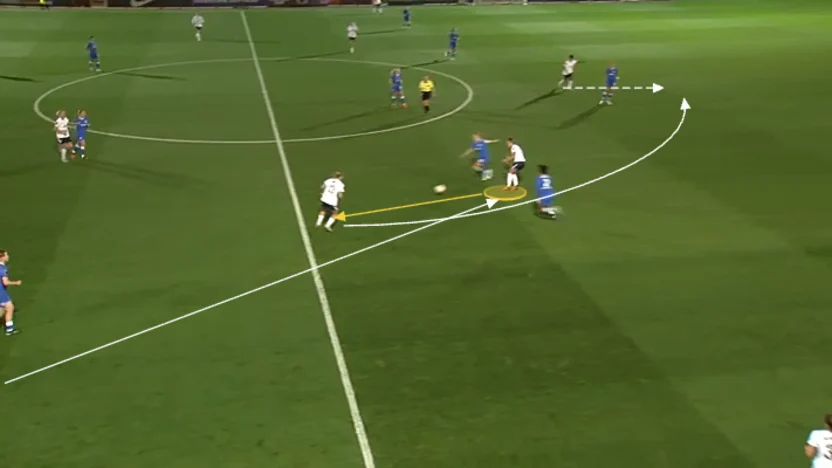
In this instance, Koga plays a ball into Pelova's feet. With two opponents surrounding her, she knows she doesn’t have time to control the ball and turn; instead, she opts for a first-time pass back to Summanen.
Pelova acts almost as a bounce player here. Her single touch ensures Tottenham retain possession and can keep building an attack without losing momentum or turning the ball over in midfield. As a result, Summanen can play a ball in behind the defensive line, which is now disjointed after the Brighton player steps out to pressure Pelova.
The quality here is in Pelova’s decision-making. With two Brighton players closing her down, she knows the forward option isn't available and shows some good awareness to ensure Tottenham keep hold of the ball.
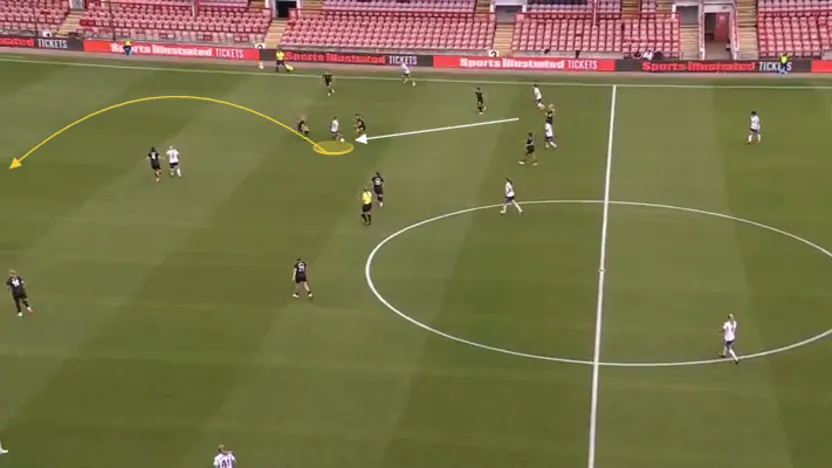
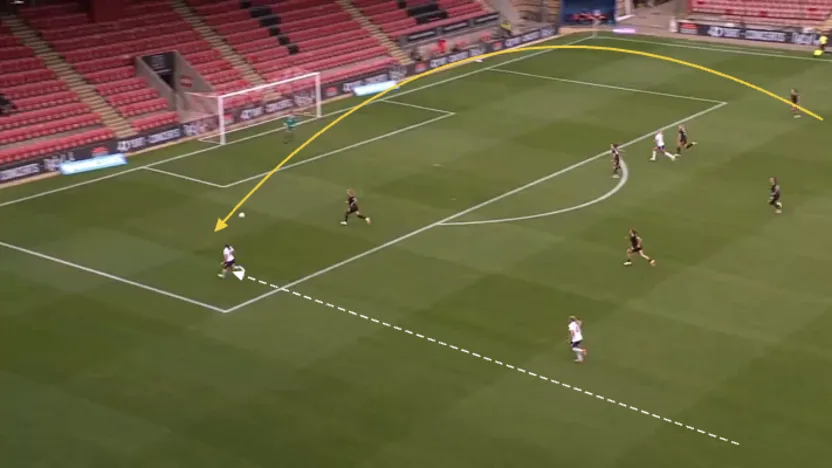
Here, we see the Tottenham midfielder’s ability to handle pressure before shifting the point of attack. She receives the ball with two opponents pressing her, uses her first touch to evade the pressure and moves into space.
This gives Pelova time and space to scan the field for runners. She spots her teammate making a run on the opposite flank. She then executes a long diagonal pass right into her teammate's path, turning what looked like a congested midfield situation into a promising attacking opportunity for Spurs.
Her ability to receive under pressure, retain possession, and create enough space for herself to then assess her options and choose the right pass is why she’s already become integral to Martin Ho’s side this season.
Defending From the Front
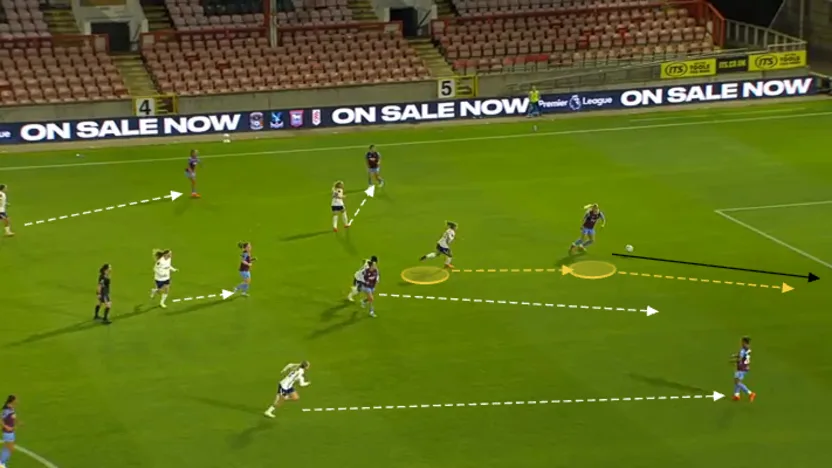
Pelova’s newfound attacking freedom doesn’t come at the expense of her work without the ball. Tottenham have recorded the lowest PPDA in the BWSL this season, at 8.05 across their opening five games.
With Martin Ho’s tactics clearly geared towards recovering possession high up the pitch, his attacking players' willingness to lead the press is crucial.
Pelova is very well suited to this approach. She is an energetic and willing runner who is prepared to repeatedly put pressure on opposition defenders rather than simply waiting for the ball to be won behind her.
In this example, against West Ham, we can see this clearly. Pelova initially closes down the centre back, forcing her to retreat rather than allowing her to play forward comfortably. As the defender eventually plays backward, Pelova continues her movement to put the goalkeeper under pressure.
This demonstrates the intensity required within Tottenham’s pressing structure. Pelova doesn't switch off; she keeps running and looks to make the next action uncomfortable for the opponent.
Her work rate is an important part of her value to Spurs. She can provide an attacking threat when Spurs have the ball, but she is equally willing to work relentlessly to help them win it back in dangerous areas of the pitch.
Conclusion
Ultimately, Pelova’s move to Tottenham feels less like a reinvention and more like a player and club who are well aligned. Her tactical role lets her influence the game in several ways, while the movement and quality of the players around her create the ideal environment for her best qualities to shine.
Her early-season performances have been impressive. She displays quick thinking, intelligent movement, the ability to adapt under pressure, and continually finds ways to be involved in the final third.
She has already become an important part of how they want to play, with and without the ball, and her performances suggest there could be considerably more to come as she becomes increasingly familiar with Ho’s ideas.
After a spell at Arsenal that never really saw the best from her, Victoria Pelova seems to be thriving on the other side of North London. So far, she looks to be an incredible signing for a Tottenham side that continues to impress under Martin Ho’s guidance.