In modern women's football, teams use different tactical approaches to turn possession into goals. The BWSL is no exception, with teams looking to dominate possession and win the ball back high up the pitch, while others rely on quick transitions to catch opponents off guard.
Chelsea and London City Lionesses provide an interesting contrast in how teams use possession, pressing and quick transitions to create goalscoring opportunities.
Chelsea's pressing power creates chances.
Chelsea follow a high-press strategy, one of the most talked-about out-of-possession approaches in the modern game. This is when a team applies pressure in the opposition's defensive third to win the ball high up the pitch. Chelsea have the highest possession in the league at 64.78%, which shows that their pressing approach works alongside, rather than instead of, possession dominance.
Chelsea's pressing requires hard work across the team, with forward and wide players helping to initiate pressure on the opposition. Players such as Alyssa Thompson and Ellie Carpenter also offer an attacking threat out wide, using their pace to drive forward with the ball. Both can get beyond defenders and deliver crosses into the opposition's penalty area. This gives Chelsea another attacking option, as they can turn a high regain into a dangerous opportunity by quickly moving the ball wide.
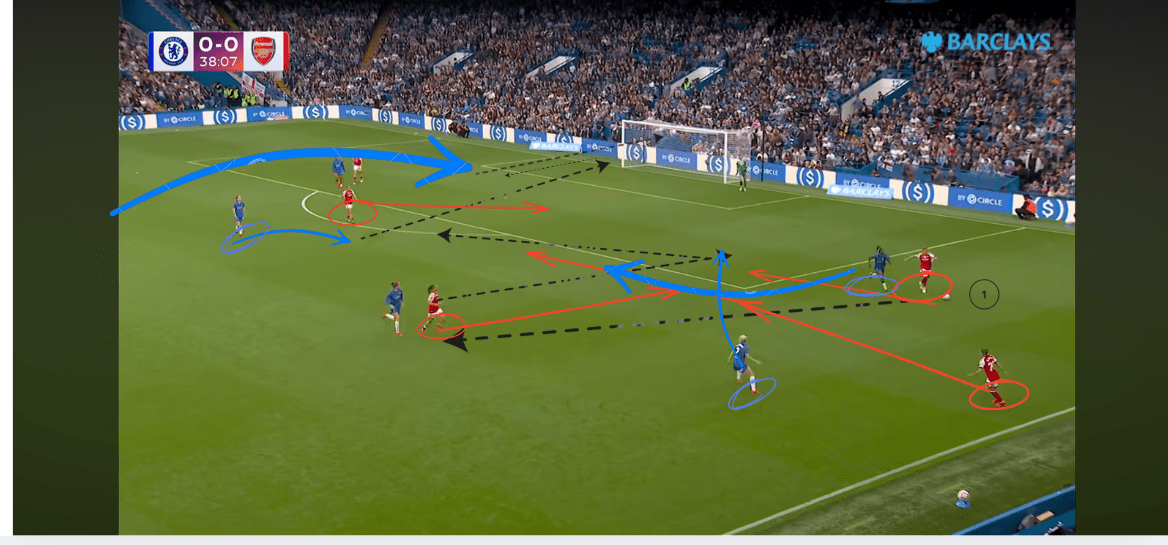
(Black dotted line is the ball movement, red lines are Arsenal players and blue is Chelsea)
An example of Chelsea putting opponents under pressure was their winning goal at Stamford Bridge in the BWSL against Arsenal in September. It started from the back, with Chelsea forward Melvine Malard pressuring Steph Catley just outside the penalty box. In response, Catley played the ball to Mariona Caldentey, who then played it back to Anneke Borbe in goal. However, Chelsea’s pressure continued, and the ball came back to Malard, who won it back before crossing to Keira Walsh at the edge of the box. Walsh shot, but the ball was pushed out by the goalkeeper. Alyssa Thompson, who had run down the far wing, then tapped in the rebound from close range.
This goal shows why it is no surprise that Chelsea have the highest possession won in the final third per match, at 10.2. This lets them win the ball close to the opposition's goal, creating chances to attack before the opposition can recover its defensive shape. Their ability to win the ball close to goal and sustain attacks has also contributed to their attacking output. They have the highest expected goals (29.9) and the highest shots on target per match (8.3). They have also created the most chances in the league, with 50.
The numbers behind Chelsea’s pressing intensity
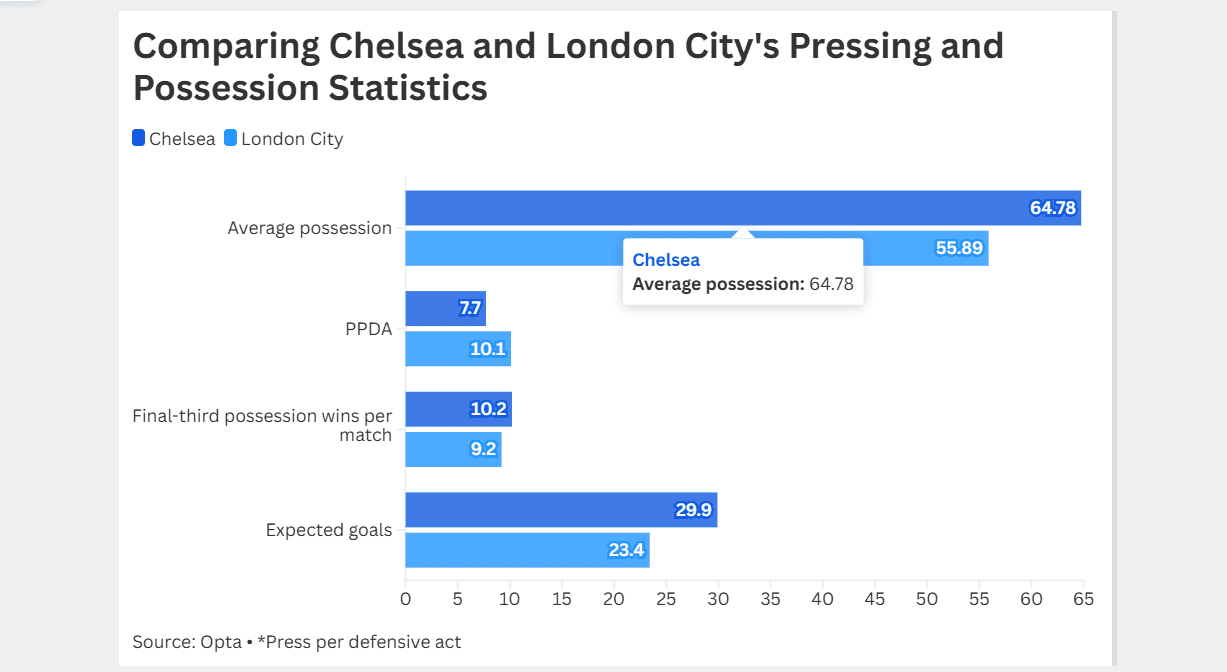
PPDA (passes per defensive action) measures how many passes an opposition team completes for every defensive action the pressing team makes in the measured areas. Chelsea's figure of 7.7 is the lowest in the league, indicating that they apply pressure more frequently than other teams. This means opponents have less time and fewer opportunities to build attacks before Chelsea attempt to win the ball back. Together with their league-high possession, these statistics show how Chelsea combine ball control with an aggressive approach to winning it back. Their pressing helps create shooting opportunities and contributes to their high expected-goals figure.
London City offer a different route to creating chances.
In contrast, London City Lionesses have adopted a style influenced by Spanish football under Spanish manager Eder Maestre. Their approach combines positional play and a “high risk, high reward” mentality, building from the back through their centre-backs and midfielders to retain possession and progress up the pitch. However, they can also switch quickly into attack when possession is recovered, using vertical passes and forward runs to exploit spaces before opponents can reorganise. Danielle van de Donk praised the team for “recovering the ball very quickly” in their 6-1 victory over Spurs.
London City's attacking width is also important to their style. Full-backs such as Lucía Corrales and Jana Fernández can push forward to provide an immediate vertical outlet, creating additional options out wide and stretching opposition defences. Their forward movement can also create central space for teammates.

(black dotted line is the ball, white line is the London City Lionesses movement leading to the goal)
This goal demonstrates how quickly London City can turn a defensive regain into an attacking opportunity. When London City Lionesses faced Brighton, their second goal, scored in the dying moments of stoppage time, began deep in their own defensive half, with Danielle van de Donk collecting the ball in midfield and starting the counter-attack. She played a through ball to her right to Delphine Cascarino, who ran up the wing into the penalty box. She then crossed to the far side of the goal, where Lucía Corrales tapped it in.
London City rank second behind Chelsea for expected goals (23.4) and sit third for big chances created (37). They also average 9.2 possession won in the final third per match. However, their attacking threat is not limited to winning the ball high up the pitch. Opta's analysis has recorded 10 fast breaks, producing nine shots and two goals. This highlights their ability to exploit space quickly when opponents are out of position.
One risk of playing with a high defensive line is the space it leaves behind for opponents to exploit. When players commit forward to press, the opposition can use direct passes to bypass the pressure and expose the space behind the defence.
An example of an opponent exploiting London's high defensive line came in Manchester City's first goal against them. Lauren Hemp threaded a pass through to Bunny Shaw, who ran in behind the defence. With the London City defenders caught too high up the pitch, Shaw found herself one-on-one with the goalkeeper and finished to score. This highlights the risk of committing players forward, as opponents can use quick, direct passes to exploit the space left behind the defence.
Chelsea and London City demonstrate how different tactical approaches can create goalscoring opportunities. While Chelsea use possession dominance and an aggressive press to win the ball high up the pitch, London City can be particularly dangerous when transitioning quickly into attack. Both approaches offer attacking benefits, but they also require teams to manage the spaces they leave behind.