Ipswich Town's first season in the Barclays Women’s Super League 2 was always going to be a challenge. After securing promotion with an emphatic 8-0 victory over Cheltenham Town on the final day of last season to clinch the third-tier title, the step up to the second tier represented uncharted territory for the club.
The opening months of the season proved difficult. By the start of December, things were not looking good. Ipswich had taken just four points from their opening nine games and were struggling to generate a consistent attacking threat. Then came the 7-0 loss to Bristol City, their heaviest defeat of the season and the moment where a rethink was needed.
The data shows that a tactical shift began under Joe Sheehan, following the defeat to Bristol; the underlying metrics had shown signs of improvement before his departure in early January. So when interim manager David Wright came in, he inherited a team that had already begun its transformation. Wright’s job, then, has been to ensure the Tractor Girls continue to move in the right direction - and on the evidence of the last four games, that is precisely what is happening.
The January window brought reinforcements. Kit Graham signed on loan from Tottenham, Malaika Meena from Bristol City, Lysianne Proulx joined from Juventus. Beyond the new arrivals, something more fundamental had already shifted. In this piece, we'll use match-by-match data to examine exactly what changed, who changed it, and whether the numbers suggest a path to survival.
The Early Struggles
Ipswich's opening eight fixtures under Joe Sheehan produced one win, one draw, and six defeats. The results were concerning. The season began with losses to Southampton and Nottingham Forest. A credible draw with Charlton Athletic, followed by a 3-2 victory against Portsmouth, suggested things were on the up, but a five-game losing streak ensured that wasn’t the case.
The underlying metrics show us where the problems were. Across the opening eight games, Ipswich averaged 45.2% possession and attempted an average of 316 passes per game, completing 72.8% of them. They averaged 46 long passes per match, with 41.96% accuracy, meaning 14.7% of their total passes were long balls. These numbers suggest a team attempting to keep the ball when possible and build attacks through possession phases.
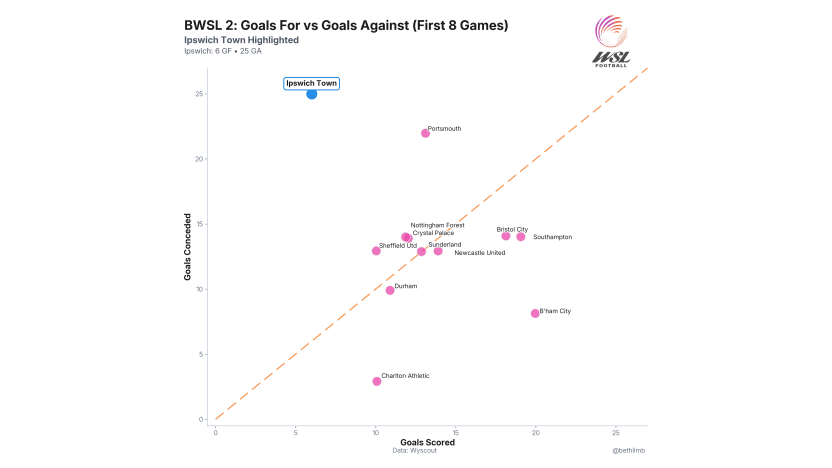
The problem was what those passes generated, or more accurately, what they didn't. Ipswich averaged just 0.8 xG per game across the opening eight fixtures, indicating they were creating very few quality chances despite attempting to build attacks. At the other end, they were conceding 3.1 goals per game on average, shipping 25 goals in total, including four against Southampton, four against Birmingham, and four against Newcastle.
The goals-for versus goals-against scatter shows us how Ipswich compared to other BWSL 2 teams during those first eight games. We can see that they were a statistical outlier removed from the rest of the division. The scatter plot shows Ipswich in the top-left corner, indicating they were conceding at a rate that was disconnected from their scoring ability.
The turning point came in Gameweek 8. The defeat to Bristol City. It was Ipswich's toughest loss of the season, leaving them with just five points from eight games. More significantly, though, it forced a tactical rethink that would kick-start their campaign and turn the relegation battle into exactly that: a battle.
The Response
The defeat to Bristol City marked rock bottom for Ipswich. Something had to change. The changes were small but have proven to be impactful. While not immediately reflected in results, there has been a fundamental shift in their approach to games.
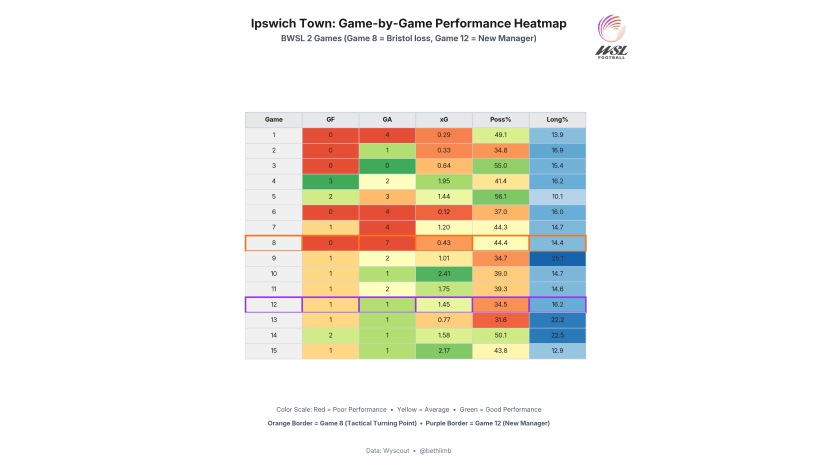
From Game 9 onwards, still under Sheehan, something changed. Possession dropped from 45.2% to an average of 37.7% across his final three games. More importantly, the underlying attacking numbers responded as well. Ipswich’s average xG per game climbed from 0.80 to 1.72, and goals conceded fell from 3.13 to 1.67 per game.
The heatmap tells the story clearly. The goals against column shows predominantly green after Gameweek 8, with no subsequent match conceding more than two goals. Meanwhile, the xG column reflects the improvement in attacking threat, including the standout 2.41 xG against Durham. This shows us that Ipswich were starting to generate goalscoring opportunities prior to Sheehan’s departure.
Despite those improved underlying numbers, the results weren't enough. Sheehan left in early January. The question of whether he deserved more time, given what the data was already showing, is a legitimate one.
David Wright arrived as interim manager, inheriting a team midway through its tactical transformation. His job has been to continue and accelerate what Sheehan had already started, and the results have begun to follow. A 1-1 draw with Bristol City, another 1-1 with Newcastle United, a 2-1 victory over Portsmouth, and a commendable 1-1 with league leaders Charlton.
Under Wright, Ipswich have averaged 1.49 xG per game, showing his tactical tweaks are generating goalscoring opportunities. The long pass percentage has also climbed, reaching 22.5%, suggesting Wright has pushed the directness a little further. The team that shipped 25 goals in eight games is starting to look considerably more solid.
David Wright’s Tactical Tweaks
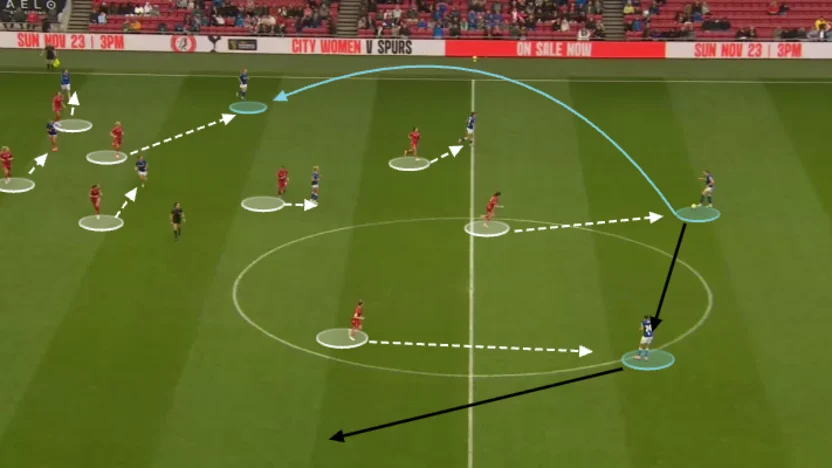
In particular, during the first eight games of the season, the Tractor Girls played straight into their opponents' hands. Here, against Bristol City, we can see Megan Wearing in possession. The Robins are clearly looking to put Ipswich under pressure and force them down the right, where, as we can see, they are engaging in a player-to-player press.
In this situation, the best option for Wearing would be to play the ball to her defensive teammate, Paige Peak, who could sweep it out to the left flank, avoiding the pressure and giving Ipswich the opportunity to drive into space. However, Wearing opts to play a chipped pass into her teammate, as shown by the blue arrow, which unfortunately invites immediate pressure from Bristol. This results in a turnover and allows the opposition to launch a counterattack, whilst Ipswich have to quickly transition into the defensive shape.
Decisions like these were a recurring theme in Ipswich's difficult early-season run. Rather than playing away from pressure and using the width of the pitch to escape, players repeatedly attempted to play through or over the opposition press. This is a high-risk approach that broke down against opponents who had a solid out of possession gameplan to limit force Ipswich into their traps.
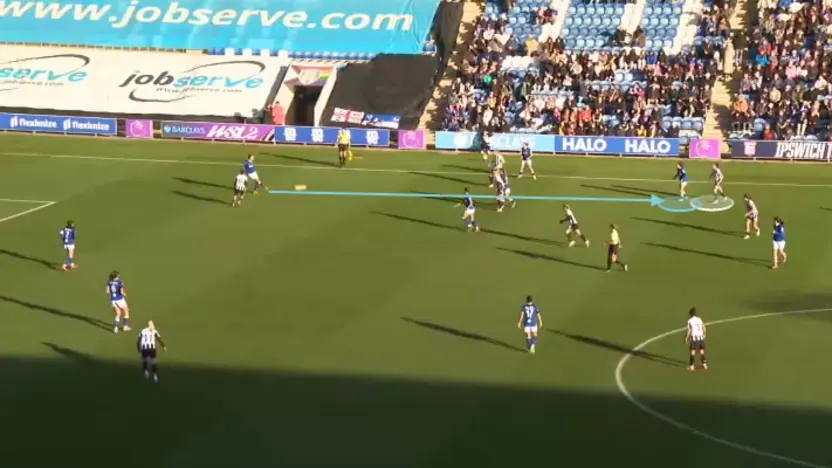
Something similar occurs here, against Newcastle United. Ipswich initially do well to regain possession, but the decision-making is rushed and, again, they attempt to play through a crowded area, which results in a turnover.
The consequences of moments like these extend beyond the immediate loss of possession. Turning the ball over in or around your own defensive third against a team pressing with intent hands momentum to the opposition.
For Ipswich in those early weeks, it became a cycle where poor decisions under pressure led to turnovers, turnovers led to transitions against them, and those transitions led to goals.
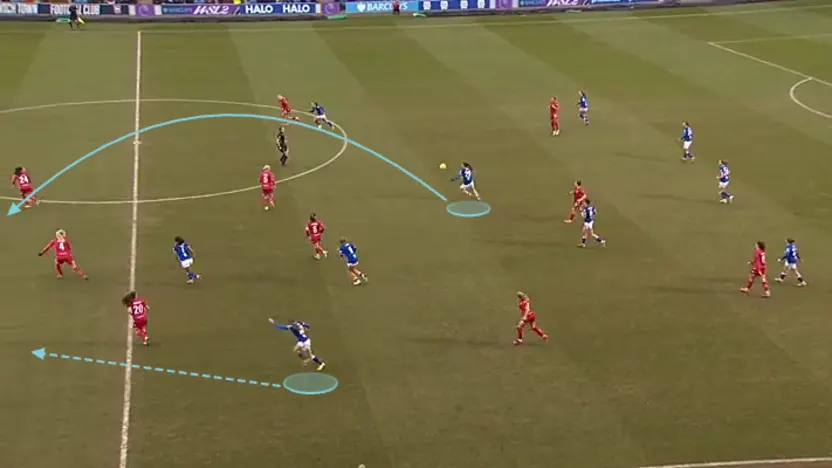
In contrast, during Wright’s first game in charge, there was an obvious change in the way Ipswich were looking to transition once they had regained possession. Instead of looking to play through crowded areas, the instructions now are clearly to catch the opposition out of shape and look to make runs in-behind the disjointed defensive line.
Here, we can see the Tractor Girls recover possession, Jenna Dear has the ball, and rather than bringing it under control and trying to build an attack or retain possession, she sees her teammate (Lucy O’Brien) looking to make a run in behind. Dear obliges and fires a pass in behind the defensive line for O’Brien to run onto. One quick pass and Ipswich have turned defence into attack.
The shift in approach is small but significant. Whereas previously Ipswich were trying to construct attacks through tight spaces under pressure (a system that demanded a high level of composure), Wright's setup asks much more direct questions of the opposition.
He asks his team to win the ball, move it quickly, and exploit the space before the defence can recover. It is a style that suits a team with willing runners such as O’Brien and Peskett.
Since Wright took over, his team has averaged an xG of 1.49 per 90 (a significant increase compared to the average xG of their first 11 games), and with their most recent fixture against Charlton producing their highest xG figure of the entire season at 2.17, there are signs that his ideas are continuing to take hold.
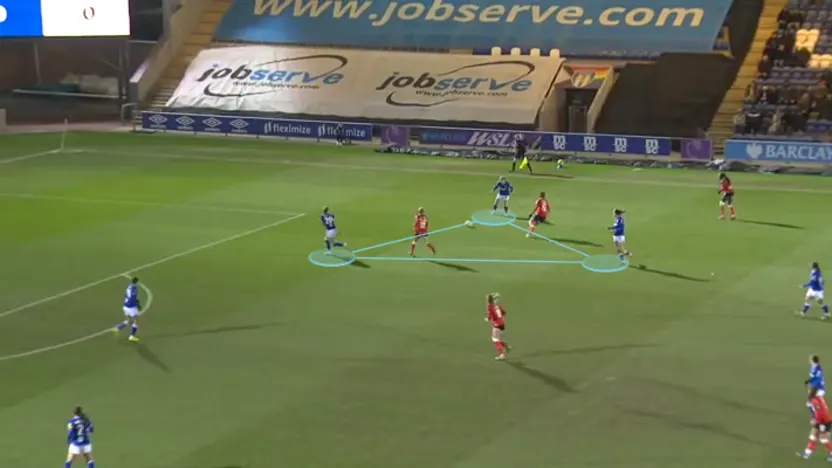
One of the more subtle but telling signs of Wright's influence is visible in Ipswich's buildup play. Where earlier in the season players stood static and isolated in possession, there is now a clear structural intent. As we can see, passing triangles are forming across the pitch, and teammates are moving into angles rather than waiting for the ball to find them. This is a small detail that carries significant tactical weight.
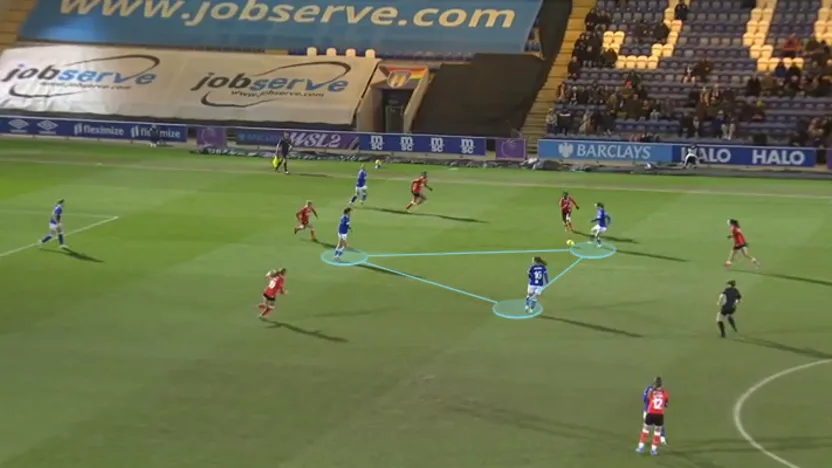
The importance of these triangles goes beyond pure aesthetics. Ipswich are now becoming a team that consistently offers the ball carrier two or three options, allowing them to play through tight areas when they want to.
By building with more positional awareness, Wright has given his players a way out of pressure rather than forcing them into the high-risk decisions that defined those early performances. The data shows that the number of progressive passes has increased to 64.5 per game under his tenure, suggesting the ball is now moving forward quickly and with purpose.
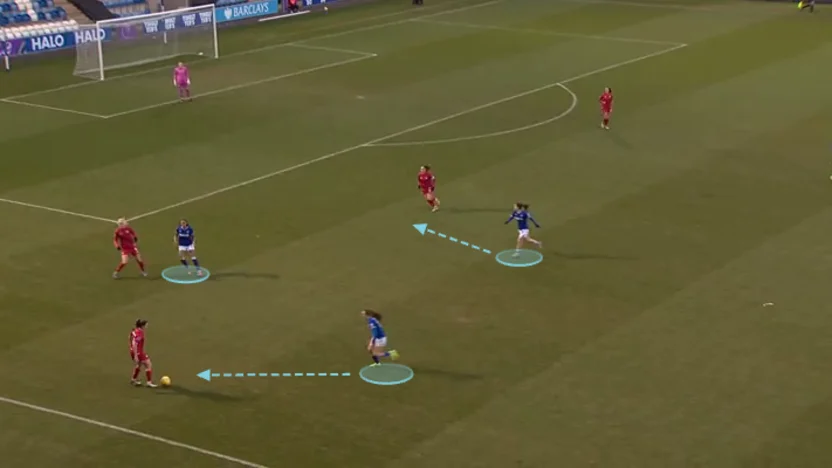
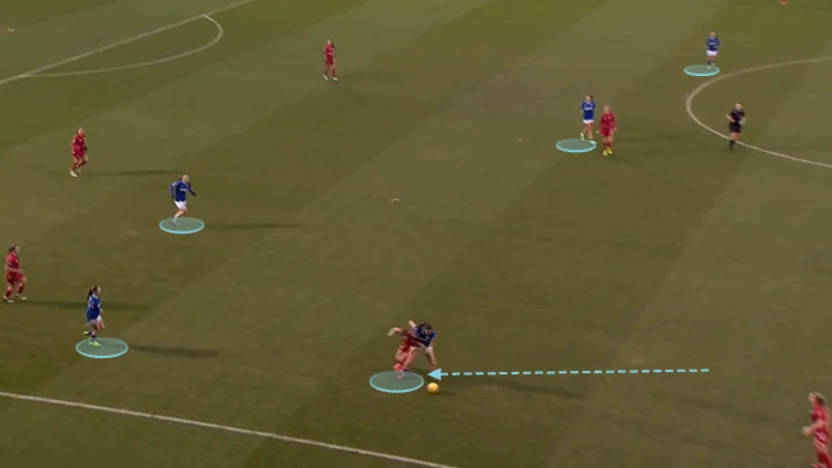
Moreover, since Wright took the reins, Ipswich have become much more selective in their pressing, often choosing to wait for optimal opportunities to press. When they do put their opponents under pressure, it is much more cohesive and well-considered.
In this instance, we can see Bristol City looking to play out of defence, and Ipswich use this to put them under pressure. The Tractor Girls force Bristol to play the ball out wide, utilising their positioning to close off passing lanes to central areas. By compressing the space and cutting off the easy option back inside, Ipswich funnel Bristol down the flank, into a controlled environment where they have numbers and the opposition have limited options. Tight marking does the rest; they force a poor touch and a turnover in exactly the area Wright's side had set up to win it.
We can see that Ipswich do not overcommit; instead, they wait and strike when the moment is right. The result is that when they do win the ball back, they are already organised to use it. In this example, five Ipswich players are ready to attack the Bristol backline once they have recovered possession.
Furthermore, set pieces have become an increasingly important weapon in recent games. Ipswich are now winning more of them. They are averaging 26.5 per game since Wright took over, compared to 23.3 in the first eleven games. More importantly, though, they are doing more with them. Corners have almost doubled, rising from 2.0 per game to 4.2, and the number of set-piece situations generating shots has increased from 2.6 to 3.2 per game.
Dead-ball situations represent one of the most reliable routes to goal, and David Wright appears to have identified that early. In a division where the margins are tight, manufacturing danger from set pieces is an excellent tactical option, and under Wright, it looks like a feature Ipswich are willing to use to their advantage.
Conclusion
The story of Ipswich Town’s season is far from over. Newly promoted sides rarely have it easy, and for Ipswich, it added up to a very tough start to life in the second tier.
This isn't simply a tale of a new manager arriving to fix a broken team. The data shows a tactical shift was already underway when Wright walked through the door. What he has done is continue to enhance it, start turning those improved underlying numbers into tangible results.
Yes, Ipswich remain in a relegation fight, but the evidence suggests they are a different team to the one that shipped 25 goals in eight games. With Wright's tactical framework now being put into practice and new signings adding much-needed squad depth, the question is no longer whether Ipswich can compete; the last four games have answered that. The question now is whether they can sustain it through the second half of the season, when margins will be tighter, and the pressure will be on.