For Poppy Pattinson, the wait is finally over. The Sunderland-born defender has represented England at every youth level from under-17 to under-23, and quietly established herself as one of the most dependable left-backs in the Barclays Women's Super League. What she had never received, until now, was a senior call-up.
That changed on Tuesday night when Sarina Wiegman handed her a second-half substitute appearance in the Lionesses' 6-1 victory over Ukraine. Her debut may signify a shift in how Wiegman is thinking about the left-back position ahead of the 2027 World Cup.
Wiegman's decision to bring Pattinson into the fold is not a shock to those who have watched her closely over the last few seasons. Some could argue that it’s overdue.
England's left back position has been something of a revolving door for years, a problem the Lionesses have never quite solved with the same authority they have brought to the rest of the pitch. Pattinson arrives as the latest candidate to change that, and on the evidence of her BWSL season with London City Lionesses so far, she may be the most compelling one yet.
In this analysis, we will use data and video to examine the tactical qualities she brings to the position. We will analyse her defensive solidity, her ability to carry the ball forward, and the specific qualities that earned her that England debut.
Role in London City Lionesses’ Tactics
Since Eder Maestre took over as head coach in January, Poppy Pattinson has featured in every game for London City, a clear indication that the former Tenerife coach sees her as his first-choice left back.
Maestre typically opts to play a 4-2-3-1 formation, with Pattinson given licence to get forward when possible and to step into more central areas to link play and offer a passing outlet during build-up. Maestre’s tactics are fluid, and roles are often interchangeable, with players required to read the game efficiently and adjust to the spaces available at any given time.
In this setup, Pattinson has begun to develop into a tactically astute defender. She is something more than a conventional left back. Rather than functioning purely as a wide outlet who looks to get to the byline and deliver, she operates as a composed ball-progressor who receives under pressure and finds the next pass quickly to move the team up the pitch.
Her role for London City Lionesses demands both technical quality and tactical intelligence, and she has grown into it quite convincingly over recent weeks.
Ball Progression
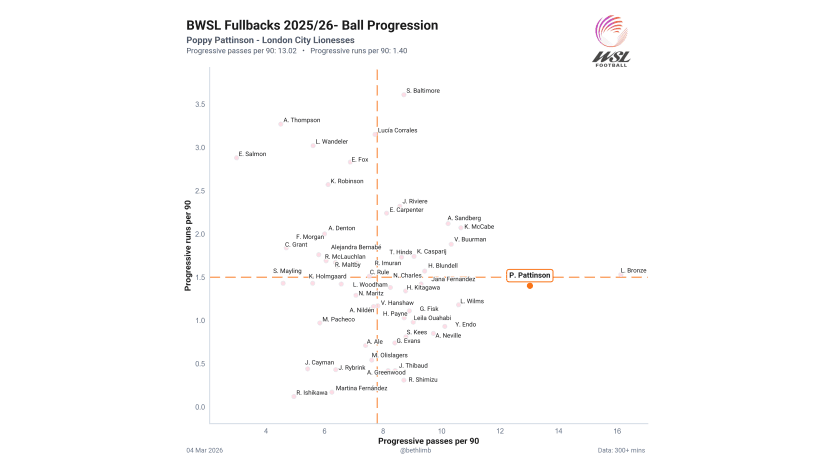
Fullbacks have become one of the most important roles in football, especially in terms of ball progression. Looking at the data, Pattinson averages 1.4 progressive runs per 90 and 13.02 progressive passes per 90. The latter places her second in the division among fullbacks, behind only Lucy Bronze, who has played a number of games at centre back, which will impact her numbers, underlining the exceptional quality of her distribution from deep.
This volume of progressive passing shows Pattinson is a player actively sought out during build-up phases and possesses the technical quality to find the pass that breaks lines.
Additionally, we can see that her progression contribution is more pass-based rather than carry-based. This tells us that she is not a fullback who advances by driving forward with the ball; instead, she does it by reading the game early and executing.
The data show that Pattinson suits a possession-based system, one that looks to play through the lines and that she is a player who knows when to play forward, when the line is breakable, and when to hold possession.
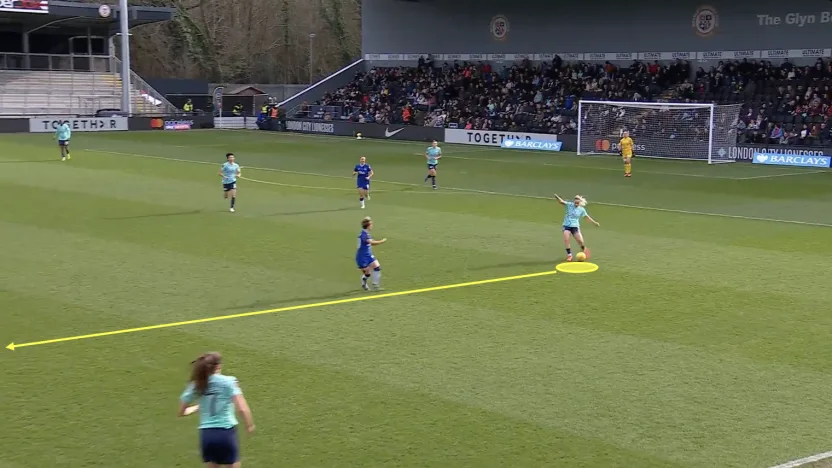

This is a great example of Pattinson's ability to break lines with a single pass from deep. Receiving the ball in her own defensive third, she identifies Kosovare Asllani's run early, before the Everton defensive line has time to reorganise and executes a pass that bypasses two-thirds of the pitch in a single action.
The result is an immediate transition into an attacking position, with Asllani running in behind the retreating defence.
Pattinson’s decision-making stands out just as much as the execution in this scenario. Her reading of the game ensures that she plays the pass at the precise moment the defensive line is vulnerable; she sees this and exploits it. A safer fullback would simply pass the ball sideways or backwards, whereas Pattinson is a forward-thinking player whose natural instinct is to attack.
This is exactly the kind of action that progressive passing metrics are designed to capture. This is not a pass that simply retains possession; it fundamentally changes the territorial and defensive situation for the opposition. In one action, London City go from passing the ball around their defensive line to attacking in the final third, and Pattinson is the catalyst.
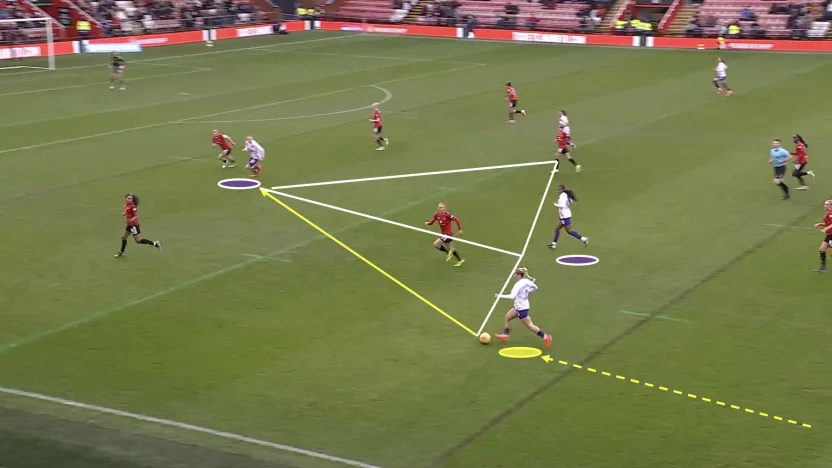
When receiving in her own defensive third, Pattinson's default is always to move forward. Here, we see the willingness to carry the ball beyond the halfway line herself when the space opens up.
In the attacking phase, Pattinson's role becomes more nuanced. London City's structure in possession relies heavily on positional rotations to create passing triangles - teammates are always moving to offer angles for whoever is in possession, dragging markers out of position and creating the pockets of space for others to receive the pass.
In this instance, we can see the former Brighton player carry the team forward and then play a pass into the feet of her teammate, who drags the defender out of position, creating space for Grace Geyoro's forward run.
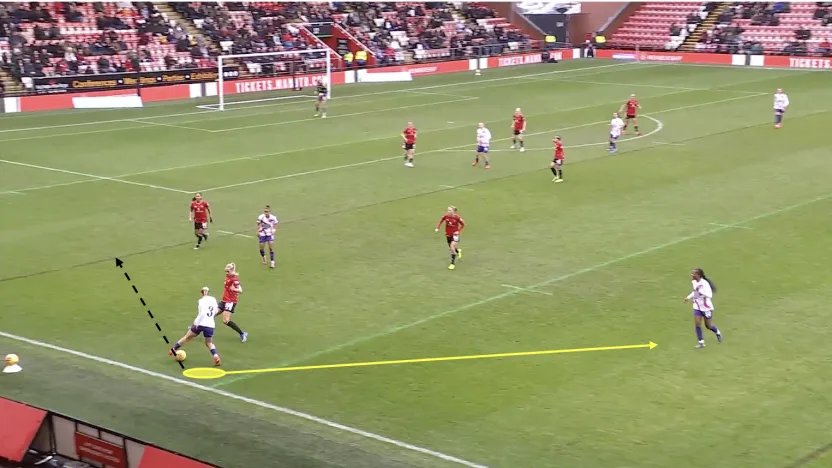
Moreover, there are times when the London City left back could be more direct with her play. Here, for example, receiving the ball in space out wide, she has a clear opportunity to drive forward down the flank as the channel is available, and a run into a crossing position would have put London City in a dangerous area. Instead, she opts for the lateral pass, retaining possession but sacrificing the forward momentum the situation offered.
This is a minor observation in the context, as possession is retained, the team stays organised, and there is no immediate risk. There are just these moments of hesitation in forward areas that could often be the difference between creating a chance and resetting. A fullback with Pattinson’s quality can back herself to drive forward and beat her opponent in 1v1 situations.
Defensive Actions
As a fullback, Pattinson’s primary role is a defensive one, and the data suggests she is performing well in these metrics as well.
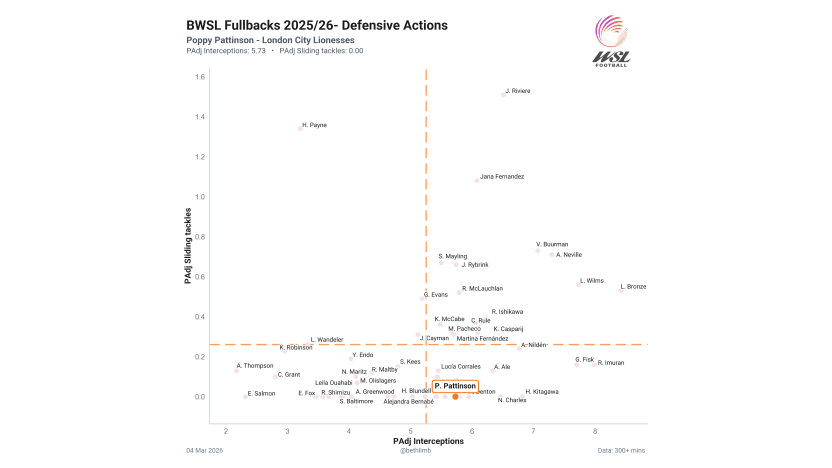
Pattinson's data paints a picture of a proactive defender. Her PAdj interception figure of 5.73 per 90 places her above the division average, suggesting she is a player who anticipates danger early and is capable of positioning herself to cut out passes before they become threats rather than waiting to deal with the consequences.
Additionally, her PAdj sliding tackle figure of 0 tells us she is a defender who either rarely finds herself in last-ditch situations (a byproduct of good positioning) or one who simply does not commit to the ground challenge when tested. The interception data suggests it's the former - if a player is intercepting at that volume, they are likely not being caught out often enough to need to make last-ditch tackles.
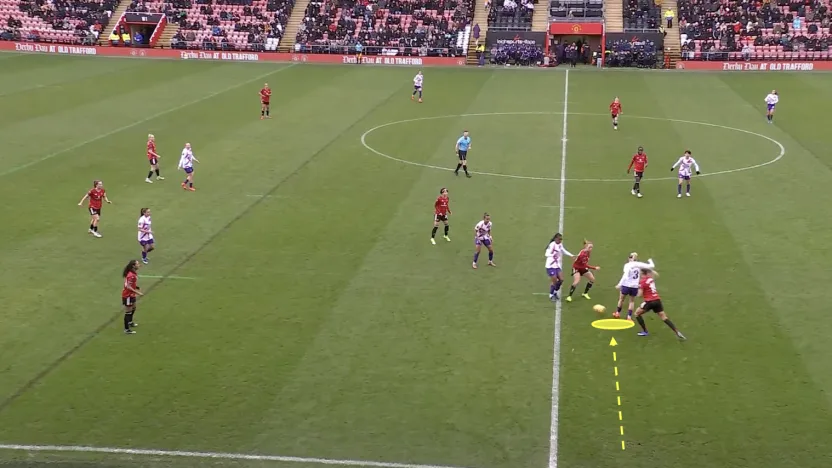
Here, the 25-year-old demonstrates excellent anticipatory defending. As London City lose possession, Pattinson does not hold her position on the touchline; she reads the developing situation instantly, using a sharp burst of acceleration to move inside and cut off the passing lane before the opposition can exploit it.
She ensures her body is between the ball and the intended recipient, making the interception a controlled action, recovering possession cleanly, and killing the opposition's attacking move before it can build any momentum.
In the context of a game, this is a small moment, but it is the kind of action that doesn’t always show up in highlight reels but defines a defensively reliable fullback. The decision to press infield rather than stay out wide is what separates a reactive defender from a proactive one.
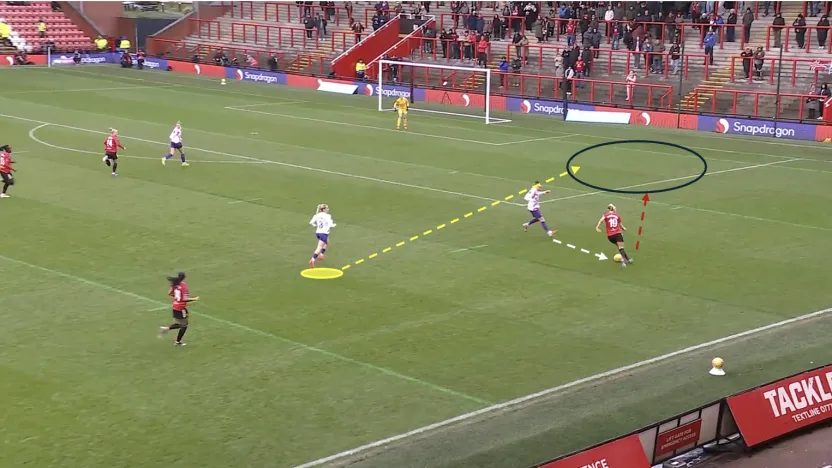
Here, Pattinson's defensive intelligence is on full display. As London City are in the defensive transition, her teammate moves to press the ball carrier. Pattinson instantly reads the space that her teammate has vacated, driving into the half-space with a sharp burst of acceleration to provide cover.
She arrives in position before the cross can be delivered, nullifying the threat through excellent anticipation and movement from a player with sharp tactical understanding.
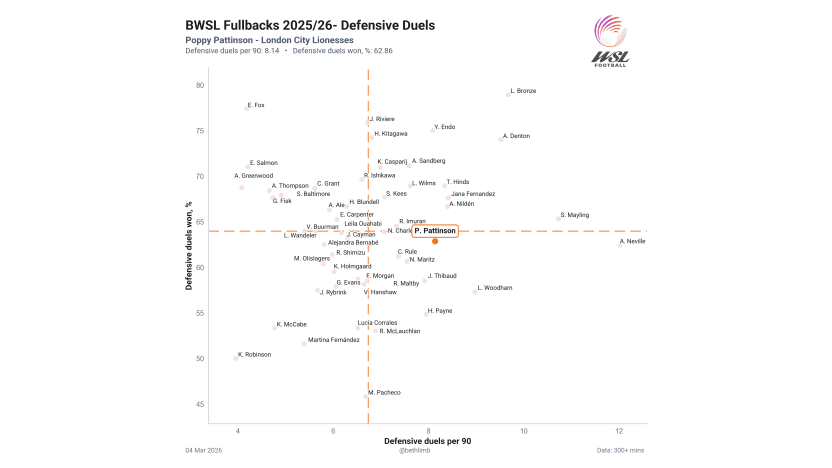
In terms of defensive duels, Pattinson's numbers show that she fullback who is heavily involved and holds her own. She averages 8.14 defensive duels per 90, making her one of the higher-volume duel participants in the division. The win rate of 62.86% sits just below the division average, meaning she wins more duels than she loses but is not dominant in one-on-one battles.
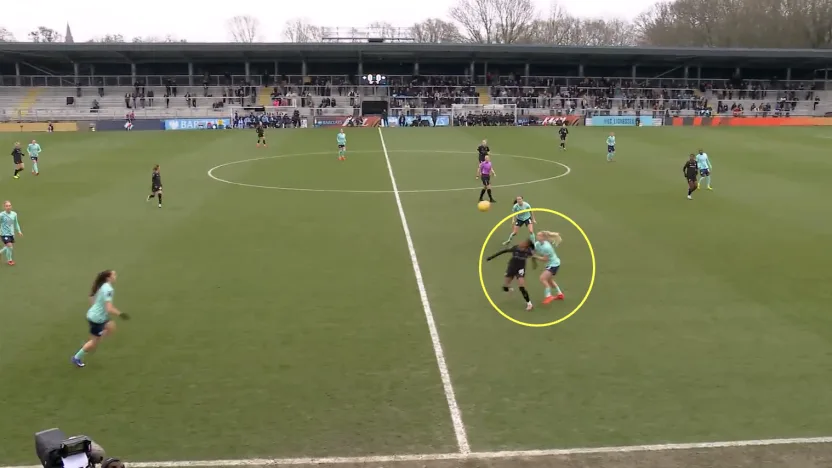
Here, Pattinson demonstrates the more physical side of her defensive game. She stays tight to her opponent and denies them the space to turn by using her positioning to force the situation on her own terms rather than allowing the attacker to dictate.
When the ground duel develops, she does not shy away from the contact, using her physical strength to engage and compete. This is the more combative side of her game, which shows that she is more than capable of using her physicality to limit the opposition’s ability to attack down her flank.
Chance Creation
The modern fullback is no longer judged solely on their ability to defend and progress the ball; creating goalscoring opportunities has become an increasingly central part of the role. As teams demand more from their fullbacks in the final third, the ability to deliver crosses, create key passes and generate expected assists has become a distinguishing marker between a good fullback and an elite one.
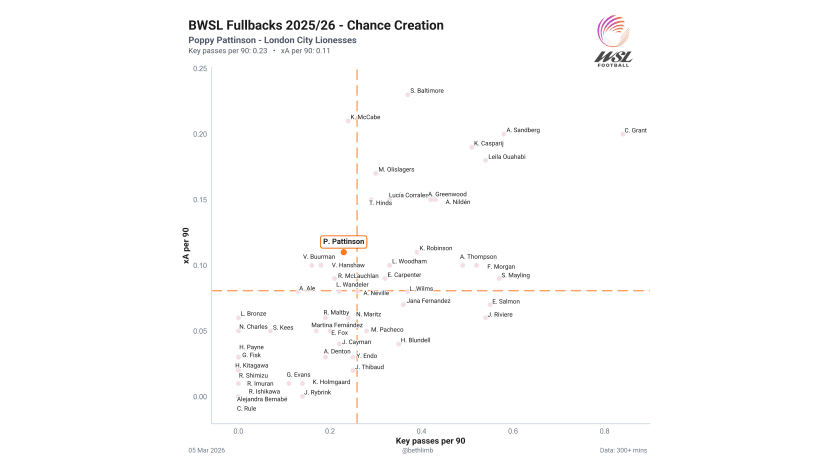
In terms of chance creation, Pattinson's numbers are modest. We can see that she has a key pass rate of 0.23 per 90 and xA figure of 0.11 per 90. For context, she is not amongst the most creative fullbacks in the division, but Pattinson is still a solid creator at this level.
That said, it is worth contextualising those numbers against her broader attacking profile. Pattinson's primary contribution in the attacking phase is progression. She moves the ball forward quickly and efficiently rather than arriving in the final third to deliver.
Her role within London City’s tactics means that she will naturally accumulate fewer key passes and lower xA, because the creative responsibility is handed off earlier in the move rather than retained into the danger area.
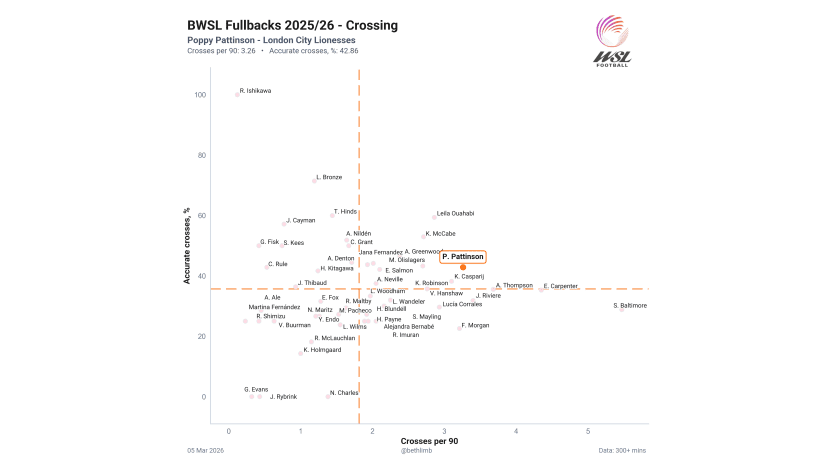
Her crossing data presents a similar picture. Averaging 3.26 crosses per 90, Pattinson is above the division average in terms of volume, so we can infer that she is getting into wide positions and committing to the delivery regularly.
Furthermore, her accuracy figure of 42.86% is also above the division average, so we can see that she is a fullback whose crossing is a decent weapon for her team.
For a player of her technical quality in possession, these crossing numbers feel like an area of untapped potential rather than a settled strength. She has the ability to progress the ball and arrive in wide positions, the next step in her development may be converting those delivery opportunities into more consistent end product.
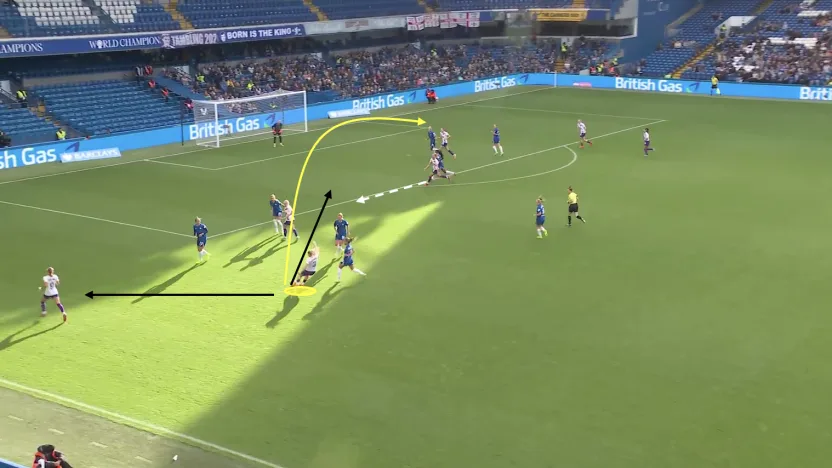
When looking into Pattinson's crossing abilities, one thing that stood out was the areas from which she executes them. As shown here, she is typically putting crosses into the box from deeper areas rather than providing overlaps out wide.
The crossing angle here is more acute, meaning the defence has more time to organise and therefore is more likely to clear the cross. It is not a criticism of Pattinson so much as an observation about how London City are using her, and it raises the question of whether, given more licence to overlap and attack down the line, she could offer something more potent in the final third than her current numbers reflect.
Additionally, there are times when Pattinson could opt against the cross entirely. Here, she has two viable passing options available. A pass out wide to a teammate down the flank, or a through ball into the space where a teammate is making a run in behind the defensive line. Either option would likely have created a more dangerous situation than the cross she ultimately delivers, which is comfortably dealt with by the defence.
Overall, Pattinson's chance creation profile is one of the more nuanced aspects of her game. She is the player who moves the team into dangerous areas, rather than being the one who consistently generates goal-scoring opportunities. However, should London City evolve their tactics to utilise the left-back as a primary creator, the evidence suggests she would adapt to the role very easily.
Conclusion
In many respects, Poppy Pattinson is the archetypal modern fullback. She is technically accomplished, tactically intelligent, and well-suited to a possession-based game that demands as much from her in the build-up phase as in defence.
Her progressive passing output is the defining feature of her profile and the clearest indicator of her quality. She moves her team up the pitch efficiently and consistently by reading the game early and making herself available under pressure.
For any manager building a possession-based system that demands intelligent, progressive fullback play, she represents exactly the kind of profile worth investing in.
At international level, the conversation is equally compelling. With England's fullback options under Sarina Wiegman continuing to evolve, and should Pattinson's performances continue to demand attention, she could cement her place in the starting eleven ahead of the next major tournament.